Barriers for Crowd Control Planner: Aluminum vs Steel Crowd Barriers
Start with a usable planner in under one minute, then validate the decision with report-grade evidence. This page explicitly covers barriers for crowd control, aluminum crowd control barriers intent, and barricade fencing intent (including barricade fence and barricade fence panels variants) while keeping one canonical URL: /learn/crowd-control-barriers.
Barriers for crowd control alias anchorBarricade fence panels alias anchorBarricade fence alias anchorLooking for barriers for crowd control or barricade fencing? This is the canonical page for that intent cluster on this site. If you searched barricade fence panels, barricade fence, barricade fencing for sale, or barricade fence for sale, this is the same canonical intent path. Use the tool first, then validate fit, boundaries, and sourcing risk in the report sections below.
Published: April 8, 2026. Last updated: June 7, 2026. Review cadence: every 6 months or when major guidance updates.
Evidence footprint: 31 cited sources including HSE, OSHA, MUTCD/FHWA, Federal Register rules, PROWAG/U.S. Access Board, FEMA, NPSA, ADA, SGSA, USGS, and state fire-code references.
Internal alias anchors
Tool Promise
Input demand and layout assumptions to get a deterministic starter quantity, material direction, risk warning, and a quote-ready brief. If the case exceeds boundary conditions, the page provides a minimum continue path instead of fake certainty.
01 · Tool Layer
Input, compute, and act
This planner is designed for operational teams that need a quick, recoverable decision path before RFQ packaging.
Primary CTA: move from quick estimate to supplier-ready RFQ package.
02 · Report Summary
Core conclusions and key numbers
HSE event guidance states barriers should be risk assessed and warns wrong barrier selection can increase risk.
HSE crowd control guidance emphasizes unlocked exits, clear pedestrian routes, and emergency arrangements before entry.
Published aluminum crowd/stage products vary significantly by design, so “aluminum” alone is not enough to estimate handling cost.
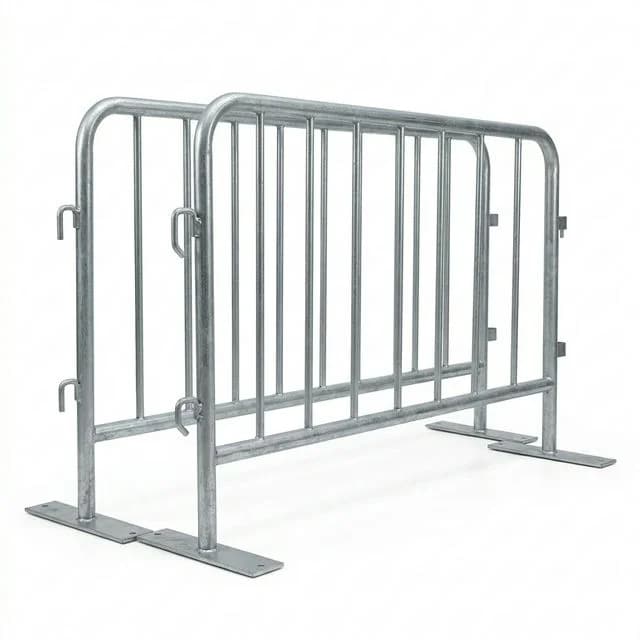
Sample steel barricade listings cluster around 8.5 ft length and low-40-lb weights in publicly listed product specs.
NPSA guidance indicates low-density behavior differs from >=0.4 p/m2 scenarios and recommends throughput reductions in specific VSB layouts.
USGS 2026 reports U.S. aluminum spot price rising from 129.5 to 180 cents/lb (2024 to 2025e), while steel mill PPI was near-flat (291 to 290).
USGS MCS 2026 reports 2025 tariff step changes for aluminum and steel in U.S. imports, so quote validity windows and alternates are mandatory on larger buys.
FHWA states had a two-year substantial-conformance window after MUTCD 11th Edition (effective January 18, 2024). Use date checkpoints in RFQs so drawing, permit, and procurement assumptions stay synchronized.
| Scenario | Fit signal | Why | Action |
|---|---|---|---|
| Rapidly changing event lanes with multiple daily resets | Aluminum-led or Hybrid | Handling speed and repeated reconfiguration dominate total cost and schedule reliability. | Prioritize modular units and verify real crew setup rate assumptions. |
| Long static perimeter with higher abuse probability | Steel-led | Rigidity and straightforward replacement economics tend to outperform lightweight priorities. | Specify foot type, lock points, and edge-control procedures in RFQ. |
| Front-of-stage crowd compression control | Dedicated stage barrier systems | This is a different engineering and operations problem than queue lane demarcation. | Use pit-specific modules and rehearse extraction and security workflows. |
| Very high peak throughput with limited line length | Boundary condition | Simple unit math can understate compression risk and operational failure modes. | Escalate to drawing-based zoning and authority validation before sign-off. |
03 · Stage1b Research Delta
Gap audit and evidence-driven fixes
This round keeps the existing tool and content structure, then fixes evidence gaps with source-traceable updates. Where public evidence is still insufficient, status remains explicitly pending.
| Gap | Risk if unfixed | Stage1b update | Evidence | Status |
|---|---|---|---|---|
| Flow-control claims lacked directional-rate boundaries under VSB overlays. | Teams can overestimate ingress throughput and keep unsafe gate-open assumptions. | Added NPSA flow references (82 people/min/m ideal, 66 people/min/m with steps/cross-flows) and retained >=0.4 p/m2 pivot with throughput reduction caveat. | NPSA VSB event-venues guidance (2025 update context). | Fixed in stage1b |
| Compliance checks over-weighted width and under-covered slope geometry. | A route can pass width checks but still fail accessibility or safe movement constraints. | Added ADA 403.3.1 running slope (max 1:20), 403.3.3 cross slope (max 1:48), and 304.3 turning space (60 in min) into threshold controls. | ADA 2010 Standards sections 403 and 304. | Fixed in stage1b |
| Procurement risk focused on spot prices, missing policy-step shocks. | Material recommendations can be operationally correct but commercially stale before PO release. | Added USGS MCS 2026 tariff-step signals and raw-steel capacity/import-reliance indicators to RFQ risk logic. | USGS MCS 2026 (full summary + aluminum + iron/steel chapters). | Fixed in stage1b |
| Emergency-response logic was implied, not translated into trigger actions. | Incident escalation may fail at route, lighting, or communication layers during live operations. | Added emergency trigger matrix with HSE incident controls and OSHA 1910.37 maintenance/lighting checks. | HSE incidents/emergencies and OSHA 29 CFR 1910.37. | Fixed in stage1b |
| Road-adjacent use lacked explicit MUTCD channelization vs crash-protection boundaries. | Teams can misapply temporary lane separators or crowd rails as positive protection and under-design pedestrian crossings. | Added MUTCD 11th Edition Revision 1 controls: temporary lane separators are not crashworthy positive protection, pedestrian crossing opening must be >=60 in, and pedestrian-channelization geometry requires detectable edging. | FHWA MUTCD Part 6 (11th Edition with Revision 1). | Fixed in stage1b |
| Regulatory updates were listed but not converted into procurement-date checkpoints. | RFQs can lock obsolete assumptions when timeline-sensitive rules change between design and purchase approval. | Added a dated regulatory clock table covering MUTCD 11th Edition effective date, state conformance window, MUTCD Revision 1 effective date, and DOT PROWAG adoption effective date. | FHWA MUTCD home/state guidance, Federal Register 2026-04365, and DOT 2024-29990 final rule records. | Fixed in stage1b |
| OSHA egress thresholds were not clearly bounded to worker-safety scope. | Teams can misread OSHA route numbers as a complete spectator-occupancy compliance framework. | Added OSHA applicability boundary (29 CFR 1910.5) and explicit code-ownership matrix to separate worker-safety floor from spectator permitting controls. | OSHA 29 CFR 1910.5 plus existing 1910.36/1910.37 requirements. | Fixed in stage1b |
| Jurisdiction-level crowd-staffing divergence lacked concrete counterexamples. | One-state staffing assumptions can be copied into another jurisdiction and fail permit or inspection review. | Added state-signal comparison rows using Massachusetts crowd-manager guidance and Rhode Island 2026 life-safety amendments to show threshold variance. | Massachusetts State Fire Marshal crowd-manager pamphlet and Rhode Island RILSC Part 8 amendments. | Fixed in stage1b |
| Jurisdiction-specific MUTCD adoption/supplement status was not visible in decision gates. | A plan can pass generic checks but still fail state/local supplement requirements at permit review. | Added governance escalation gates requiring state DOT/local authority confirmation before final drawings. Kept status pending until project jurisdiction is confirmed. | FHWA MUTCD home timeline (effective dates January 18, 2024 and March 5, 2026). | Pending confirmation / 暂无可靠公开数据 |
| The exact alias "barricade fencing" still lacked a visible concept-boundary table. | Searchers can confuse event crowd-control barriers with construction barricades, MUTCD roadway barricades, plastic safety mesh, or HVM barriers and buy the wrong control layer. | Added an alias boundary matrix that separates crowd/event fit from construction hazard exclusion, roadway TTC barricades, plastic/orange mesh, and vehicle-threat controls. | HSE event-barrier guidance, OSHA 1926 barricade definition context, MUTCD Part 6, and FEMA mass-gathering security guidance. | Fixed in stage1b |
| The exact alias "barriers for crowd control" was missing from canonical copy, FAQ, anchors, and metadata. | Commercial searchers could miss that the live planner answers their request and a separate duplicate page might look necessary. | Added the alias to route metadata, Article/SoftwareApplication schema, H1/intro copy, alias anchors, FAQ, evidence-gap language, and product-page internal anchor text. | OpenSpec alias-merge decision for add-kw-barriers-for-crowd-control-page plus the existing crowd-control barrier planner/tool structure. | Fixed in stage1b |
| Temporary accessible-route execution was stated too broadly and lacked field-checkable details. | A drawing can show an alternate route while the installed barrier feet, signs, or channelizers still fail accessible-route continuity. | Added a field execution checklist using PROWAG R201.2/R204.1 plus R303 signals: alternate pedestrian access route, 48 in continuous clear width, advance decision-point signs, and continuous detectable edging when channelizers define the route. | U.S. Access Board PROWAG complete/scoping/technical pages, rechecked June 7, 2026. | Fixed in stage1b |
| Exit-route guidance did not explicitly catch temporary storage and barrier feet as obstruction risks. | Crews may pass a pre-event drawing review but block an exit route during resets, staging, or night operations. | Added OSHA eTool-backed checks for at least two remote exit routes, free/unobstructed access, adequate lighting, visible exit marking, and no temporary materials or equipment inside the exit route. | OSHA 1910.36, 1910.37, and OSHA evacuation eTools, rechecked June 7, 2026. | Fixed in stage1b |
| Crowd-risk assessment did not explicitly cover full movement cycle or vulnerable audience profiles. | Barrier choice can optimize ingress queue order while missing arrival, internal movement, exit, dispersal, disability, or young-person risks. | Added HSE-backed full-cycle checkpoints: arrival, entry, venue movement, exit/dispersal, disabled/young-person considerations, and competent contractor escalation for complex barrier arrangements. | HSE crowd-risk assessment and using-barriers-at-events guidance, rechecked June 7, 2026. | Fixed in stage1b |
| Cross-vendor setup-rate benchmark remains non-harmonized in public data. | Crew-time assumptions may look precise but remain non-comparable across suppliers. | Kept this item explicitly unresolved; page now requires pilot deployment timing before procurement freeze. | Public evidence review across supplier listings and standards pages. | Pending confirmation / 暂无可靠公开数据 |
| Search intent | Usually means | Canonical fit | Do not assume | Minimum next step | Source signal |
|---|---|---|---|---|---|
| Event queue, pedestrian lane, or venue perimeter | Crowd-control barriers, bike-rack barricades, or modular event barriers. | In scope for this page and planner when the goal is pedestrian flow, queue discipline, or temporary event separation. | Do not assume front-of-stage load control, vehicle impact protection, or code approval from the phrase alone. | Run the planner, then split zones into queue, perimeter, and front-stage duty before RFQ. | HSE says event barriers should be risk assessed and selected by planned use, layout, ground, weather, load, and crowd behavior. |
| Construction hazard exclusion or worker access control | A physical obstruction or warning boundary used to deter passage near hazards. | Partially related only if the buyer needs portable metal crowd rails around a low-pressure access point. | Do not replace task-specific construction safeguards, fall-protection controls, excavation protection, or competent-person review. | Confirm the governing OSHA/construction standard and hazard before selecting a product family. | OSHA interpretation context cites 29 CFR 1926.203(a): barricade means an obstruction to deter passage of persons or vehicles. |
| Road closure, lane channelization, or work-zone control | MUTCD Type 1/2/3 barricades, longitudinal channelizing devices, temporary lane separators, or temporary traffic barriers. | Out of scope for standard event barricade purchase unless the event edge touches public-road traffic control. | Do not treat crowd rails, lane separators, or longitudinal channelizers as crashworthy positive protection. | Escalate to traffic-control drawings and authority review before procurement. | MUTCD Part 6 distinguishes barricades/channelizers from crashworthy temporary traffic barriers and sets a 60 in pedestrian crossing opening for lane separators. |
| Orange, plastic, PVC, mesh, or caution-fence wording | Visual warning mesh, light-duty safety fencing, or temporary construction separation. | Usually not the same intent as metal crowd-control barriers; treat as a separate safety-mesh or temporary-fence requirement. | Do not use mesh as a substitute for crowd-pressure control, stage-pit systems, or abuse-prone perimeter lines. | Route the requirement to safety mesh, debris netting, or temporary fence panels depending on hazard and wind load. | HSE warns incorrect barrier selection can increase risk; public supplier mesh listings are not harmonized crowd-load evidence. |
| Vehicle threat, hostile-vehicle mitigation, or standoff | Vehicle-security barriers, standoff planning, or HVM/VSB overlays. | Adjacent decision layer only. Crowd-control barriers may organize people but are not vehicle-impact protection. | Do not infer crash rating, vehicle stopping performance, or police/security approval from event barricade wording. | Add a dedicated security workstream, define standoff intent, and recalculate pedestrian flow around the VSB layout. | FEMA soft-target guidance prompts vehicle-distance and temporary/fixed barrier decisions; NPSA warns VSB layouts can change pedestrian flow. |
04 · Methodology
Formula logic, assumptions, and boundary handling
| Input | Planner rule | Boundary | Fallback |
|---|---|---|---|
| Peak crowd per hour | Transforms demand into flow segments (700-1200 people/h per segment assumption by deployment type). | 200 to 120000 people/hour | Outside range triggers error state with required manual planning path. |
| Protected line length | Converts meters to baseline units using 2.5 m (queue/perimeter) or 1.0 m (front-stage) segment length. | 20 to 8000 m | Large-site ranges force drawing review confidence downgrade. |
| Daily reconfiguration cycles | Applies +5% quantity pressure per cycle to account for reset friction and replacement drift. | 0 to 24 | High cycles increase aluminum handling score and contingency recommendation. |
| Site risk + ground condition | Shifts material score toward steel under high abuse or slope constraints. | Low/Medium/High + Flat/Mixed/Slope | High-risk outputs force warnings and stronger stewarding actions. |
| Deployment type | Front-stage, perimeter, and queue lanes are scored with different throughput and material assumptions. | Queue / Perimeter / Front-stage / Mixed | Mixed mode defaults to hybrid recommendation when score delta is narrow. |
Uncertainty policy
If public evidence is incomplete or use-case mismatch is detected, the page labels unknowns as N/A and provides escalation actions.
05 · Evidence Layer
Source-backed numbers and boundaries
| Source | Material | Dimensions | Weight | Relevance |
|---|---|---|---|---|
| Crowd Control Warehouse (steel barricade listing) | Pre-galvanized steel | 8'5" length, 45" height | 44 lb | Reference point for commodity steel lane barriers. |
| Epic Crowd Control (steel heavy-duty listing) | 16 gauge steel | 8.5 ft length, 43" height | 42 lb | Confirms similar steel-range weight in a second listing. |
| Milos barrier catalog PDF (multiple models) | Aluminium alloy EN AW-6082 T6 | Model-dependent (examples around 1035 x 1250 x 1185 mm) | 19.1 kg to 48 kg shown in sampled models | Shows broad aluminum-system variance by module purpose. |
| Epic Crowd Control (aluminum stage straight unit) | Aluminum | 1 m W x 1.25 m D x 1.2 m H | 66 lb / 30 kg | Illustrates front-stage module profile versus lane barricades. |
| BarrierHQ (aluminum front-of-stage 4 ft) | Aluminum | 54.85 in L x 48 in W x 48 in H | 122 lb / 55.3 kg | Shows that some aluminum safety modules are heavy due to geometry and load intent. |
| Public standards-grade like-for-like weight benchmark | N/A | N/A | N/A | Open harmonized benchmark not found; treat cross-supplier values as directional only. |
| Source | Supports | Time context | Note |
|---|---|---|---|
| HSE: Using barriers at events | Barrier purpose, risk-assessment requirement, and wrong-selection warning. | Rechecked June 7, 2026; page states barrier/fencing use should be risk assessed and wrong selection can increase risk. | Operational guidance source. |
| HSE: Put crowd controls in place | Before-entry, live-operation, and emergency crowd control checks. | Metadata extraction: 2025-04-04, accessed April 8, 2026. | Operational control checklist source. |
| OSHA: Crowd Management Safety Guidelines for Retailers (PDF) | Staffing plan, training rehearsal, and emergency coordination actions. | Document context from extraction: 2023-10-24, accessed April 8, 2026. | Useful procedural baseline; sector context differs by event type. |
| NPSA: Vehicle Security Barriers at Event Venues | Flow-rate caveats (82 to 66 people/min/m in constrained conditions), density pivot logic, and VSB caveats. | Published/updated context: September 15, 2025, accessed May 17, 2026. | Security-flow interaction source. |
| HSE: Planning for incidents and emergencies | Emergency trigger planning, communication channels, and evacuation-preparedness controls. | Last updated January 20, 2026, accessed May 17, 2026. | Emergency control baseline source. |
| HSE: Stage barriers | Stage barrier geometry, trapping-point avoidance, and pressure-zone controls. | Rechecked June 7, 2026; page confirms multiple-barrier escape arrangements should be agreed with local and fire authorities. | Front-of-stage operational guidance source. |
| ADA 2010 Standards: Accessible Routes (Section 403) | Accessible route width, slope/cross-slope limits, and turning-space baseline values. | 2010 standard text, accessed May 17, 2026. | Accessibility baseline; final obligations depend on jurisdiction/use. |
| OSHA 29 CFR 1910.36: Design and construction for exit routes | Minimum exit-route width baseline and obstruction rule. | Regulation text rechecked June 7, 2026; at least two remote exit routes are required except allowed single-route cases. | Workplace baseline; local event/venue code can be stricter. |
| OSHA 29 CFR 1910.37: Maintenance and safeguards for exit routes | Exit-route maintenance, obstruction control, and visibility/lighting checks. | Regulation/eTool text rechecked June 7, 2026; no temporary materials/equipment in exit routes and adequate lighting/marking required. | Operational maintenance baseline source. |
| OSHA 29 CFR 1910.5: Applicability of standards | Scope boundary: standards apply to employment and places of employment, clarifying OSHA as worker-safety baseline. | Regulation text, accessed May 23, 2026. | Boundary source to prevent overextending OSHA into all spectator-code decisions. |
| OSHA interpretation: barricade definition context | Construction-safety boundary for "barricade" as a warning/access-control obstruction, not automatically an event crowd barrier. | Interpretation dated March 10, 2004; accessed June 7, 2026 for alias-boundary audit. | Used only to define construction-context ambiguity, not event product performance. |
| FHWA MUTCD Home (11th Edition + Revision 1 timeline) | Current-edition status, national effective dates, and state adoption timeline context. | Page shows Revision 1 (December 2025), 11th Edition effective January 18, 2024, and Revision 1 final rule date March 5, 2026; accessed May 23, 2026. | Primary U.S. traffic-control governance source. |
| FHWA MUTCD state information and conformance notes | State manuals must reach substantial conformance within 2 years under 23 CFR 655.603(b)(1). | Page indicates two-year conformance requirement and update cadence notes; accessed May 23, 2026. | State-adoption timing source for procurement-date gating. |
| Federal Register 2026-04365 (MUTCD Revision 1 final rule) | Revision 1 effective date (March 5, 2026) and clarification that updates are technical corrections. | Published March 5, 2026, with immediate effective date, accessed May 23, 2026. | Revision-impact boundary source. |
| MUTCD 11th Edition Part 6 (TTC devices and pedestrian controls) | Temporary lane separator non-crashworthy boundary, >=60 in crossing opening, and pedestrian channelization geometry values. | 11th Edition with Revision 1 context (December 2025), rechecked June 7, 2026. | Primary technical boundary source for road-adjacent deployments. |
| U.S. Access Board PROWAG (R2 scoping) | Temporary closure obligation to provide alternate pedestrian access routes in public right-of-way contexts. | PROWAG final-rule era content, rechecked June 7, 2026. | Accessibility continuity source for temporary closures and reroutes. |
| U.S. Access Board PROWAG (R3 technical requirements) | 48 in continuous clear width, advance signs, surface continuity, curb-ramp/blended-transition requirements, and detectable edging for channelized alternate pedestrian access routes. | PROWAG technical content rechecked June 7, 2026. | Turns accessibility scoping into field-measurable barrier-layout checks. |
| U.S. Access Board PROWAG preamble | Publication and effective dates for the PROWAG final rule (published August 8, 2023; effective October 7, 2023). | Preamble effective-date context, accessed May 23, 2026. | Regulatory timeline source for accessibility obligations. |
| DOT final rule adopting PROWAG for transit stops (2024-29990) | DOT adoption timeline for transit-stop construction/alteration requirements (effective January 17, 2025). | Published December 18, 2024, accessed May 23, 2026. | Transit-adjacent closure-routing timeline source. |
| FEMA soft-target action guide (Mass Gatherings) | Connect-plan-train-report framework, vehicle standoff advice, and temporary/fixed vehicle-barrier decision prompts. | FEMA file path indicates March 2020 publication window; accessed May 23, 2026. | U.S. soft-target baseline; treat as procedural guidance, not a substitute for local mandates. |
| SGSA SG01: Safe standing in seated areas (PDF) | Reference crowd-density and barrier load values in Green Guide context. | Supplementary Guidance 01 (July 2022), accessed April 8, 2026. | Sports-ground context; verify applicability for non-sports events. |
| Massachusetts State Fire Marshal crowd manager pamphlet | State-level crowd-manager threshold and exemption examples used as jurisdiction-variance signal. | Pamphlet version marked 6/23, accessed May 23, 2026. | State guidance example; confirm current adopted edition with local AHJ. |
| Rhode Island Life Safety Code Part 8 amendments | State amendment signals (updated March 1, 2026) adding occupancy-triggered crowd-management and firefighter requirements. | Current rule page shows effective/update context around March 1, 2026; accessed May 23, 2026. | Jurisdiction counterexample source for staffing/operations variance. |
| USGS MCS 2026: Aluminum | U.S. aluminum price movement, production value, and import-reliance data. | Published February 2026 (MCS 2026), data includes 2025 estimates, accessed April 8, 2026. | Procurement volatility reference. |
| USGS MCS 2026: Iron and Steel | Steel producer price and production trend context. | Published February 2026 (MCS 2026), data includes 2025 estimates, accessed April 8, 2026. | Cross-material cost-signal comparison source. |
| USGS MCS 2026: Iron and Steel Scrap | Scrap-linked steel input price movement context. | Published February 2026 (MCS 2026), data includes 2025 estimates, accessed May 17, 2026. | Replacement and spot-buy risk reference. |
| USGS MCS 2026 full report (Version 1.2) | 2025 section 232 tariff-step context used in procurement boundary updates. | Published February 6, 2026; publication page now lists Version 1.3, May 2026; rechecked June 7, 2026. | Policy-shift context source. |
| Crowd Control Warehouse steel barricade listing | Public steel sample dimensions and weight range. | Accessed April 8, 2026. | Supplier listing; not a harmonized standard. |
| Epic Crowd Control steel listing | Second steel sample for cross-check. | Accessed April 8, 2026. | Supplier listing; directional benchmark only. |
| Milos crowd barriers catalog PDF | Aluminum model spread (material, dimensions, and weight variance). | Catalog year 2019, accessed April 8, 2026. | Model-family evidence for aluminum variability. |
| Epic Crowd Control aluminum stage barrier listing | Aluminum stage module example with 30 kg unit profile. | Accessed April 8, 2026. | Use-case-specific supplier sample. |
| BarrierHQ aluminum front-stage listing | Heavy-duty aluminum front-stage unit example (55.3 kg). | Accessed April 8, 2026. | Shows aluminum can be heavy when geometry changes. |
| Milestone | Date | What changed | Why it matters | Source |
|---|---|---|---|---|
| U.S. Access Board PROWAG final rule | Published August 8, 2023; effective October 7, 2023 | Finalized accessibility requirements for pedestrian facilities in the public right-of-way. | Temporary closure plans now need alternate accessible-route logic tied to PROWAG scoping. | U.S. Access Board PROWAG preamble |
| DOT PROWAG adoption for transit stops | Published December 18, 2024; effective January 17, 2025 | DOT adopted PROWAG requirements for transit-stop construction and alteration in ROW contexts. | Transit-adjacent barrier layouts require alternate-route documentation earlier in permit packages. | Federal Register 2024-29990 (DOT final rule) |
| MUTCD 11th Edition final rule | Effective January 18, 2024 | Established the current national baseline for temporary traffic control devices and pedestrian channelization logic. | Road-adjacent event layouts should anchor drawings to 11th Edition control language, not legacy assumptions. | FHWA MUTCD home |
| State MUTCD substantial-conformance window | 2-year window from January 18, 2024 to January 18, 2026 | States are required to update their manual/supplement into substantial conformance with the national MUTCD. | RFQs should pin the state supplement version used for design review to avoid cross-edition ambiguity. | FHWA MUTCD state conformance guidance |
| MUTCD Revision 1 final rule | Published and effective March 5, 2026 | Revision 1 is characterized as technical corrections and clarifications to the 11th Edition. | Do not assume every revision invalidates geometry; verify whether the local supplement has already incorporated the correction set. | Federal Register 2026-04365 |
| Metric | 2024 | 2025e | Decision implication | Source |
|---|---|---|---|---|
| U.S. section 232 tariff signal (aluminum/steel imports) | Pre-step-change baseline | March: 25% step changes; June: 50% steel and broader aluminum escalation in USGS reporting | Quote windows crossing policy steps need indexed alternates and explicit validity terms. | USGS MCS 2026 summary + commodity chapters |
| U.S. aluminum market spot price (cents/lb, annual average) | 129.5 | 180 | Strong upward movement raises re-quote risk for aluminum-heavy packages. | USGS MCS 2026 aluminum datasheet |
| Value of U.S. primary aluminum production | Baseline | $2.6B (+35% YoY) | Budget assumptions that rely on prior-year pricing can understate replacement and expansion cost. | USGS MCS 2026 aluminum datasheet |
| U.S. aluminum net import reliance (% of apparent consumption) | 62 | 60 | Import-exposed supply means landed-cost assumptions should include policy and logistics buffers. | USGS MCS 2026 aluminum datasheet |
| Steel mill producer price index (1982=100) | 291 | 290 | Steel indicator remained comparatively stable in this cycle; material mix can hedge volatility. | USGS MCS 2026 iron and steel datasheet |
| U.S. raw steel production capacity (million tons/year) | 107 | 105 | Slight capacity contraction can tighten replacement timing in peak demand windows. | USGS MCS 2026 iron and steel datasheet |
| No.1 heavy melting steel scrap delivered price (USD/metric ton) | 314.85 | 319 | Scrap-linked steel inputs moved moderately, still requiring quote-validity controls. | USGS MCS 2026 iron and steel scrap datasheet |
| Claim area | Status | Why unresolved | Minimum action |
|---|---|---|---|
| Open, harmonized global test-load benchmark for temporary crowd barriers by class | Pending confirmation / 暂无可靠公开数据 | Public pages point to standards/guidance, but full comparable test datasets are not openly aggregated. | Collect supplier-specific test reports and engineer sign-off before final selection. |
| Single universal egress-width rule that applies to every venue and jurisdiction | Pending confirmation / 暂无可靠公开数据 | Regulatory ownership differs by jurisdiction, occupancy, and permit conditions. | Validate route widths with local fire/building/event authorities for the specific event plan. |
| Cross-vendor verified setup-rate benchmark for identical crew and site constraints | Pending confirmation / 暂无可靠公开数据 | Public supplier listings rarely disclose audited deployment methods under comparable field conditions. | Run pilot deployment tests and lock crew-rate assumptions into the RFQ. |
| Site-specific emergency egress simulation outcome for your exact layout | Pending confirmation / 暂无可靠公开数据 | No public data can represent your unique geometry, crowd composition, and operations plan. | Require venue-specific modeling or authority-reviewed drills before procurement freeze. |
| Cross-jurisdiction crowd-manager staffing ratio that is universally binding | Pending confirmation / 暂无可靠公开数据 | Public guidance varies by code set, occupancy type, permit conditions, and local authority enforcement. | Lock staffing ratio in writing with the governing authority before final procurement and operating plan freeze. |
| Project-specific adoption status of MUTCD 11th Edition Revision 1 and local supplements | Pending confirmation / 暂无可靠公开数据 | National effective dates are public, but state/local supplement cadence and interpretation can differ by jurisdiction; public state-status pages are not always real-time permit evidence. | Confirm current state MUTCD supplement and local traffic authority requirements before permit submission. |
| Exact product class intended by a generic "barricade fencing" searcher | Pending confirmation / 暂无可靠公开数据 | The phrase appears across event, construction, roadway, plastic mesh, and vehicle-security contexts; public keyword data alone does not prove product class. | Ask for use case, hazard, traffic adjacency, crowd pressure, and authority requirements before quoting. |
| Separate search intent for "barriers for crowd control" beyond the canonical crowd-control barrier planner | Pending confirmation / 暂无可靠公开数据 | The phrase reverses the canonical word order but still points to the same commercial task unless the buyer specifies roadway, construction, mesh, or vehicle-threat context. | Keep the query merged to /learn/crowd-control-barriers and ask for use case before quoting or splitting content. |
Mid-page CTA
Ready to turn the planner output into an RFQ package?
If your baseline is clear, jump to the conversion section and submit assumptions. If not, rerun the tool first to avoid quote drift.
06 · Comparison
Material and system tradeoffs
| Option | Best for | Speed | Risk profile | Cost signal |
|---|---|---|---|---|
| Aluminum-led event modules | Fast resets, touring events, modular pit layouts | High handling speed when workflow is trained | Medium if lane abuse is high and anchoring assumptions are weak | Higher unit price, often lower handling friction |
| Steel bike-rack style barricades | Static lines, repetitive perimeter control, budget control | Moderate setup speed | Lower drift risk in rough-use lanes | Lower unit acquisition in many commodity listings |
| Hybrid package (aluminum + steel) | Mixed events with both static and reconfigurable zones | Balanced | Lower overall if zones are mapped correctly | Procurement complexity rises, but operational fit improves |
| Lightweight temporary fencing substitute | Low-pressure separation where crowd crush risk is minimal | Fast on simple layouts | High misuse risk if deployed for front-pressure control | Can appear cheap but may fail the use-case |
| Vehicle-security barrier overlay (VSB/HVM layer) | Sites with vehicle-threat model near pedestrian routes | Slower planning cycle due to layered security checks | Flow risk rises if crowd movement assumptions are not recalculated for VSB geometry | Separate CAPEX + design coordination; not a crowd-barrier replacement |
| Roadway TTC barricades and channelizers | Road closures, work zones, and traffic-channelization tasks | Depends on traffic-control plan, visibility, ballast, and authority rules | High misuse risk if substituted for event crowd pressure or vehicle-impact protection without engineering review | Different procurement category; quote separately from crowd-control rails |
07 · Compliance and Thresholds
Critical limits before procurement freeze
| Control | Threshold | Scope | Action |
|---|---|---|---|
| Accessible route width (ADA 2010 §403.5.1 and §403.5.3) | 36 in minimum; 32 in allowed for max 24 in segments; passing spaces every 200 ft when route width <60 in. | U.S. accessibility baseline for pedestrian circulation where ADA obligations apply. | Keep barriers, feet, and queue hardware outside clear route geometry in drawings and field setup. |
| Accessible route slope and turning space (ADA 2010 §403.3 + §304.3) | Running slope max 1:20; cross slope max 1:48; turning space 60 in minimum diameter/turn. | Applies where ADA accessibility obligations govern temporary or reconfigured pedestrian routes. | Include slope and turning checks in walk-through QA, not just width checks on drawings. |
| Exit access width (OSHA 29 CFR 1910.36(g)(2)) | Exit access at least 28 in at all points; projections must not reduce below minimum. | U.S. workplace egress baseline; venue/event authorities can set stricter conditions. | Treat 28 in as floor, not target. Validate final egress geometry with local AHJ and permit conditions. |
| Exit-route maintenance and visibility (OSHA 29 CFR 1910.37) | Routes must be free/unobstructed and adequately lighted so people with normal vision can see along the route. | U.S. workplace egress maintenance baseline; useful as a no-obstruction and visibility floor for event operations. | Add pre-open obstruction and lighting checks to every zone handover, including temporary hardware and stored equipment. |
| OSHA scope boundary (29 CFR 1910.5(a)) | Applies to employment and places of employment; does not by itself replace public-assembly occupancy and permitting controls. | U.S. worker-safety governance boundary used when event operations include employer-managed crews. | Treat OSHA numbers as a floor, then confirm spectator circulation and occupancy controls with fire/building/event authorities. |
| Stage barrier geometry (HSE Stage Barriers) | Typical sections around 1200 mm high and 1 m wide; no access gates on pressured sections. | UK event-safety operational guidance for crowd-pressure zones. | Match barrier class to zone pressure and avoid mixing lightweight lane hardware into pit-control duty. |
| Trapping-point avoidance (HSE Stage Barriers) | Avoid concave pockets and penning; multiple-barrier systems require escape planning with authorities. | Front-of-stage and large-venue crowd-pressure layouts, especially outdoor events. | Run pre-event walkthrough to confirm side escapes, steward lanes, and extraction access remain usable. |
| Standing-density reference (SGSA SG01, Green Guide reference) | Conventional standing recommendation: max 4.7 persons/m2 (~0.21 m2 per person). | Sports-ground standing accommodation reference; applicability must be checked for non-sports events. | Use as conservative screening input, then calibrate with venue-specific crowd modeling and licensing rules. |
| Barrier horizontal load references (SGSA SG01) | Type 11: 1.5 kN/m; Type 12: 2.0 kN/m where relevant in Green Guide context. | Sports-ground barrier engineering reference, not a universal global standard. | Request model-specific test and fixing documentation before purchase approval. |
| VSB flow impact (NPSA 2025) | Directional flows can reduce from ~82 to ~66 people/min/m in constrained conditions; at >=0.4 p/m2 certain VSB layouts may require ~10% throughput reduction. | Vehicle-security overlays near event routes (Zone Ex / pedestrian-vehicle interaction). | If VSB is added, recalc ingress/egress capacity and do not reuse crowd-barrier assumptions unchanged. |
| Temporary lane separator boundary (MUTCD 11th R1 §6K.11) | Separators are channelization devices; not crashworthy positive protection. Height max 4 in, width max 1 ft. At pedestrian crossings, opening/path must be at least 60 in. | Roadway-adjacent queues, temporary traffic control zones, and event edges open to public travel. | If vehicle-impact risk exists, add a separate positive-protection barrier design workstream; do not rely on lane separators or crowd rails alone. |
| State MUTCD substantial-conformance window (23 CFR 655.603(b)(1)) | State manual/supplement must be in substantial conformance with the national MUTCD within 2 years of the effective date. | U.S. state-level traffic-control governance for projects touching roadway operations. | Capture state supplement version/date in RFQ assumptions and verify local applicability before permit submission. |
| Pedestrian channelization geometry (MUTCD 11th R1 §6K.02) | Detection plate bottom <=2 in above walkway; top >=8 in; hand-trailing edge 32 to 38 in. | Temporary or detoured pedestrian routes in TTC contexts where accessibility and detectability are required. | Verify route hardware with field measurements after setup, not only in drawings. |
| Exit-route redundancy and door operation (OSHA 29 CFR 1910.36(b), (d), (e)) | At least two exit routes for prompt evacuation (unless a safe single-route exception applies); doors open from inside without keys/tools; doors for rooms >50 occupants swing in direction of egress. | U.S. workplace/event operations where OSHA egress baseline is used as a safety floor. | Before opening, verify route count, door hardware behavior, and door-swing conflicts against live barrier placement. |
| Temporary closure access continuity (PROWAG R201.2 and R204.1) | If pedestrian circulation path is temporarily closed, provide an alternate pedestrian access route. | Public right-of-way and transit-adjacent alterations/closures where PROWAG-based obligations are triggered. | Do not approve barrier layout until the alternate accessible route is drawn, signed, and field-checkable. |
| Alternate pedestrian access route technical checks (PROWAG R303.2-R303.6) | 48 in minimum continuous clear width; decision-point signs; surface no less accessible than closed route; curb ramp/blended transition where crossing curbs; detectable edging when channelizers define the route. | Public right-of-way temporary closures, construction/maintenance/event edges, and transit-adjacent reroutes where PROWAG obligations apply. | Add a field-measurement line item to the RFQ and require supplier drawings to show usable width outside barrier feet, ballast, signage, and gaps. |
Scope warning
If vehicle-threat mitigation is required, add a dedicated VSB/HVM workstream and recalculate pedestrian flow. Do not treat standard crowd-control rails as crash-rated barriers.
| Decision gate | Primary authority | Boundary | Minimum action |
|---|---|---|---|
| Worker route clearance and egress maintenance | OSHA 29 CFR 1910.5, 1910.36, 1910.37 | OSHA governs worker-facing safety baselines in places of employment; it is not a full public-assembly occupancy code by itself. | Use OSHA as floor controls, then document spectator/occupancy checks under the governing local code set. |
| Roadway-adjacent channelization vs positive protection | MUTCD Part 6 (11th Edition + Revision 1) | Lane separators and channelizers direct flow; crashworthy temporary traffic barriers are a separate device class. | Split crowd channelization and vehicle-impact protection in drawings when vehicle threat or live traffic exists. |
| Temporary closure and reroute accessibility | PROWAG R201.2 + R204.1; DOT 2024-29990 | If a pedestrian circulation path is closed, an alternate pedestrian access route is required unless technical infeasibility is justified. | Publish alternate-route geometry/signage in permit documents before procurement freeze. |
| Assembly staffing and crowd-management thresholds | State/local fire and building authority (AHJ) | Thresholds can vary by state amendment and adopted code edition, even within similar occupancy categories. | Obtain written AHJ confirmation of staffing/operations assumptions before PO and event-plan lock. |
| Checkpoint | Verified rule | Applies when | Procurement action | Unresolved limit |
|---|---|---|---|---|
| Alternate route created before closure | PROWAG R201.2/R204.1: temporary pedestrian facilities are covered; when a pedestrian circulation path is temporarily not accessible, provide an alternate pedestrian access route unless technically infeasible. | Sidewalk, crosswalk, transit-stop access, or other public-right-of-way pedestrian circulation is closed or narrowed by barriers. | Require a route drawing, signage plan, and field measurement sign-off before purchase order release. | Project-specific technical infeasibility cannot be confirmed from public data; AHJ/owner documentation is required. |
| Clear width measured after hardware is installed | PROWAG R303.4: alternate pedestrian access routes have a 48 in minimum continuous clear width, exclusive of curb width. | Channelizers, barrier feet, ballast, storage pallets, or queue rails sit near the alternate accessible route. | Specify usable clear width in the layout, not just nominal corridor width; include ballast and footprint dimensions in supplier submittals. | Final pass/fail depends on installed geometry and local route constraints. |
| Signs and detectable edging are budgeted | PROWAG R303.2 requires signs identifying alternate routes in advance of decision points; R303.6 requires continuous detectable edging when channelizing devices delineate the route, except permitted gaps. | Temporary barriers redirect pedestrians, especially blind or low-vision users, around a closed path. | Quote route signs and detectable edging as part of the barrier package instead of treating them as day-of accessories. | Exact sign placement remains route-specific and should be checked in field walkthrough. |
| Exit route stays free during resets | OSHA eTool/1910.37: exit routes must be free and unobstructed; no materials or equipment may be placed temporarily within the exit route. | Crews stage spare barriers, feet, pallets, or carts near gates, corridors, ramps, or exit discharge paths. | Add staging zones to the layout and require reset-cycle inspections before each public opening window. | OSHA is a workplace floor; spectator occupancy and event-permit rules can be stricter. |
| Lighting and exit marking survive night operation | OSHA 1910.37 requires each exit route to be adequately lighted so an employee with normal vision can see along it and exits to be clearly visible and marked. | Events operate after dark, under smoke/special effects, in temporary tents, or through low-light emergency routes. | Include lighting, backup power, and sign-visibility checks in barrier handover, not only in electrical planning. | Final illumination adequacy depends on venue-specific lighting measurements. |
| Audience profile changes barrier duty | HSE crowd-risk guidance requires considering crowd movement across arrival, entry, movement, exit, and dispersal, including young people and people with disabilities or learning difficulties. | Family events, school groups, high-intensity performances, unfamiliar venues, or events ending after dark change crowd behavior assumptions. | Ask for audience profile and dispersal plan in the RFQ intake; do not quote only from linear meters. | Public guidance cannot predict a specific event audience; organizer-provided profile remains required. |
| Trigger | Official signal | Failure mode | Minimum control | Source |
|---|---|---|---|---|
| Forecast severe weather, structural risk, or utility outage | HSE requires planning for incidents and emergencies, including evacuation and liaison with emergency services. | Late trigger calls can force unmanaged crowd movement and route conflicts. | Publish trigger thresholds, owner names, and communication chain before audience entry. | HSE incidents and emergencies |
| Route obstruction discovered during setup or live operations | OSHA 1910.37 requires exit routes to remain free and unobstructed. | Barrier feet, storage, or ad-hoc hardware can silently invalidate egress assumptions. | Run a zone-by-zone obstruction sweep before opening and after every reset cycle. | OSHA 29 CFR 1910.37 |
| Night operation, smoke, or reduced visibility conditions | OSHA 1910.37 requires adequate lighting for route visibility; HSE emergency planning includes dedicated emergency lighting logic. | Routes that pass daytime checks can fail under low-visibility stress. | Test lighting fallback and signage legibility in the same time window as actual operation. | OSHA 29 CFR 1910.37 + HSE incidents guidance |
| Security overlay adds VSB/bollard geometry changes | NPSA warns that crowd-flow assumptions can change materially with VSB layouts. | Throughput assumptions remain unchanged while effective path capacity drops. | Recalculate ingress/egress flow and issue revised stewarding plan before deployment. | NPSA VSB event venues guidance |
| Vehicle approach lanes remain close to high-density congregation zones | FEMA soft-target guidance advises keeping vehicles a safe distance and assessing fixed/temporary vehicle barriers. | Crowd lanes look organized but vehicle approach risk remains untreated and emergency response roles stay ambiguous. | Define standoff intent, speed-reduction measures, and who authorizes temporary vehicle barriers before gates open. | FEMA Mass Gatherings Action Guide (soft targets) |
| Trigger | Why boundary shifts | Minimum escalation action | Primary source |
|---|---|---|---|
| Pedestrian queue/perimeter directly adjacent to live vehicle lanes or street traffic | MUTCD treats lane separators and longitudinal channelizers as flow-control devices that are not crashworthy positive protection. | Split design into crowd channelization + positive-protection package and run authority review before procurement. | MUTCD 11th Edition Part 6 (Sections 6K.10 and 6K.11) |
| Sidewalk, crosswalk, or transit-adjacent pedestrian path is temporarily closed or rerouted | PROWAG requires an alternate pedestrian access route when circulation paths are temporarily inaccessible. | Publish alternate route geometry/signage and validate route continuity in field walkthroughs. | PROWAG R201.2 + R204.1 (U.S. Access Board) |
| Egress logic depends on one route, or barrier placement changes door/route behavior in operation | OSHA exit-route standards require redundancy, accessible door operation, and outward swing for >50 occupant rooms. | Run an egress pre-open inspection that checks route count, unlocked door operation, and conflict points. | OSHA 29 CFR 1910.36 |
| Threat model or law-enforcement briefing flags vehicle-ramming risk at approach zones | FEMA soft-target guidance adds standoff and vehicle barrier decisions beyond normal crowd-lane planning. | Coordinate with security authorities, set standoff strategy, and document vehicle-barrier ownership. | FEMA Mass Gatherings Action Guide (soft targets) |
| Jurisdiction | Trigger | Requirement signal | Procurement impact | Status |
|---|---|---|---|---|
| Massachusetts (state guidance example) | Crowd-manager thresholds and exceptions in State Fire Marshal pamphlet (document marked 6/23). | Guidance references threshold logic and exemption handling (for example fixed seating and certain short-duration events). | Do not copy ratio assumptions without checking the currently adopted state/local edition and permit conditions. | Confirmed source; applicability still jurisdiction-specific. |
| Rhode Island (RILSC Part 8 amendments) | Rule text updated March 1, 2026 includes occupancy-triggered crowd-management and uniformed-firefighter requirements for certain assembly conditions. | Amendments add supervision and response-layer controls beyond base barrier-count math. | Barrier procurement must be tied to staffing and response obligations, not treated as a stand-alone hardware decision. | Confirmed source; verify event classification with AHJ. |
| Project target state/local AHJ (your site) | Current state supplement edition date and local permit interpretation for the specific venue/use case. | No universal public tracker guarantees real-time alignment across all state/local amendments. | Treat this as a hard pre-PO gate: freeze assumptions only after written local authority confirmation. | Pending confirmation / 暂无可靠公开数据 |
08 · Risks and Mitigations
What can fail and how to reduce damage
| Risk | Impact | Probability | Mitigation |
|---|---|---|---|
| Material selected by price only | High | High | Run a use-case split: queue lane, front-stage, and perimeter cannot share one blind default. |
| Barrier line blocks emergency routes | High | Medium | Validate route clearance and emergency logic before audience entry, not during live operations. |
| Ground-condition mismatch (slope/wet) | Medium | Medium | Audit foot type and anti-lift assumptions; pilot one zone under expected weather. |
| Density surge beyond planned throughput | High | Medium | Expand lanes, stage arrivals, and add overflow redirection points. |
| Assuming aluminum always means lighter handling | Medium | High | Compare actual unit weight and geometry for the exact barrier class, not material label alone. |
| Treating crowd barriers as crash-rated vehicle barriers | High | Medium | Separate crowd-control and vehicle-security requirements; if VSB is needed, redesign flow and capacity assumptions. |
| Non-compliant route widths after barrier deployment | High | Medium | Audit clear widths against governing code set and permit conditions before gate opening, then field-verify with installed feet and accessories. |
| Ambiguous "barricade fencing" requirement routed to the wrong product family | High | High | Before RFQ, classify the need as event crowd control, construction hazard exclusion, roadway TTC, plastic mesh, or vehicle-security protection. |
09 · Scenario Examples
Four practical use cases
Process: Planner biases toward aluminum-led or hybrid due to handling frequency.
Outcome: Faster reset rhythm and lower overtime risk when crew workflow is prepared.
Process: Planner tilts steel-led and raises route discipline warnings.
Outcome: Lower replacement churn and more stable perimeter behavior.
Process: Planner marks dedicated stage modules + boundary caution for detailed engineering review.
Outcome: Avoids unsafe substitution of lane barriers for pit-control function.
Process: Hybrid package with zone-specific SOP and staffing map.
Outcome: Better flow control and fewer day-of rework decisions.
| Scenario | Input profile | Model output | Operational note |
|---|---|---|---|
| Festival ingress (rapid resets) | 4200/h | 180 m | queue lanes | 6 reset cycles/day | 94 units | Aluminum-led | 3.6 install hours | Frequent resets swing the score to aluminum-led handling speed. |
| City perimeter (long static window) | 2500/h | 380 m | general perimeter | high risk profile | 160 units | Steel-led | 7.6 install hours | High-abuse and static-control assumptions favor steel-led rigidity. |
| Mixed concourse + premium queue | 3600/h | 260 m | mixed deployment | 3 reset cycles/day | 120 units | Hybrid package | 5.2 install hours | Near-tie scores keep the recommendation in a zone-split hybrid setup. |
10 · FAQ
Decision-focused answers
11 · Conversion Layer
Move from estimate to executable RFQ
Send your planner output with zone assumptions and we will return a scope-matched recommendation (aluminum-led, steel-led, or hybrid) with explicit boundary notes.
Inquiry email
Best for quotations, custom sizes, bulk orders, and delivery questions.
Use-case split
Queue lane, perimeter, and stage-pit needs mapped separately.Evidence policy
Unknown values are labeledN/A instead of guessed.Action output
Starter quantity, material direction, risks, and next-step checklist.