
Hot-Dip Galvanized vs. Pre-Galvanized Temporary Fence Panels: Weld-Seam Corrosion, Micron Thickness Standards, and Rental Fleet Lifecycle TCO
Compare hot-dip galvanized vs. pre-galvanized temporary fence panels, check weld protection and micron standards, and request a quote using your fleet TCO.
For rental yard operators, civil contractors, event suppliers, and import distributors, the coating on temporary fence panels affects maintenance and replacement decisions. A quotation that says only "galvanized" leaves an important question unanswered: was the zinc applied before or after the panel was welded?
Executive procurement summary:
- Pre-galvanized temporary fencing is assembled from previously zinc-coated tube and wire. Welding can damage that coating around joints; the finished panel's performance depends on the original coating specification and the quality of subsequent weld protection. It can be an economical choice where exposure, appearance requirements, and the intended holding period permit it.
- Hot-dip galvanized after fabrication (batch HDG) means the welded assembly is galvanized afterward. This can coat welds and accessible internal surfaces, provided the design permits cleaning, venting, and zinc drainage. Confirm the finished assembly's certificate and inspection results rather than relying on the word "hot-dip."
- Fleet economics depend on your records. Compare delivered cost, repair labor, replacement purchases, utilization, and residual value over the same period. Neither a guaranteed lifespan nor a universal cost saving follows from the coating name alone.
Published and reviewed: November 10, 2026. Scope: global procurement of steel temporary fence panels, in English. This guide compares coating choices and supplier evidence; it does not establish structural capacity, wind resistance, or local site compliance. Standards apply according to the purchase specification and jurisdiction. The financial example is hypothetical, not fleet test data or a supplier quotation.
For an upcoming purchase, request a coating-specific panel quotation with your destination, panel drawing, quantity, exposure conditions, and intended fleet holding period. Compare compatible temporary fence panels, fence bases and feet, and fence clamps and couplers as one assembly.
1. The Manufacturing Divide: Pre-Galvanized vs. Batch Hot-Dip
The useful distinction is the manufacturing sequence. Pre-galvanizing is a timing description; it does not establish a single coating thickness or mean electroplating. Continuously hot-dip galvanized materials and electro-zinc-coated materials are different specifications and should be identified separately on a quotation.
PRE-GALVANIZED PANEL:
Coat tube / wire -> cut and weld panel -> protect damaged weld areas -> inspect

HOT-DIP GALVANIZED AFTER FABRICATION:
Cut and weld panel -> clean and flux -> immerse assembly in zinc -> drain -> inspect
Pre-Galvanized (Mill-Galvanized / In-Line Coated)
Suppliers may form tube from coated strip, use tube coated on a continuous line, or combine separately coated frame and mesh components. Ask which process applies to each component. A certificate for incoming strip or wire establishes its own material condition, not the coating condition at the finished panel's welds.
Welding heat can melt, displace, or vaporize zinc near the joint. The affected area depends on the welding process, joint geometry, heat input, and original coating. It is inaccurate to assign the same bare radius or failure date to every weld. Inspect wire intersections, mesh-to-frame attachments, tube joints, cut ends, and any later drilled holes.
Zinc-rich repair coatings can provide useful protection when the selected system, preparation, film thickness, and curing are controlled. Silver color or an aerosol application alone proves neither adequacy nor failure. Ask for the repair product data and process record, including how awkward mesh junctions are cleaned and covered.
Hot-Dip Galvanized After Fabrication (Batch HDG / Post-Galvanized)
A typical batch process includes:
- Fabrication: Complete the specified cutting, welding, and openings before galvanizing. Agree vent and drain arrangements with the galvanizer for the actual hollow-section geometry.
- Cleaning: Remove grease, scale, and oxides, then apply flux before immersion.
- Galvanizing: Immerse the assembly in molten zinc, commonly around 450°C, so accessible, properly prepared steel surfaces can develop a bonded coating.
- Finishing and inspection: Drain excess zinc, cool the panel, and inspect coverage, thickness, finish, fit, and any permitted repairs. Specify compatibility of any after-treatment with later painting or powder coating.
Internal protection requires access for cleaning solutions and zinc. Blocked passages, trapped air, and poor detailing can leave uncoated areas. "Dipped after welding" is a process requirement, not proof that every internal surface has passed inspection.
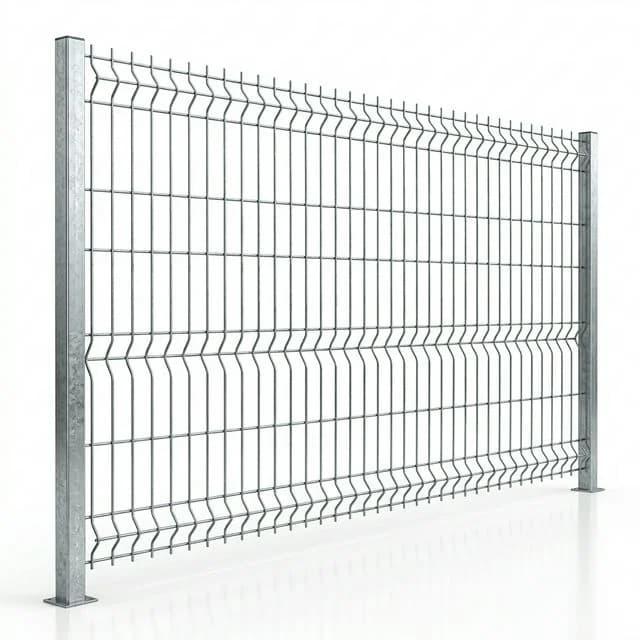
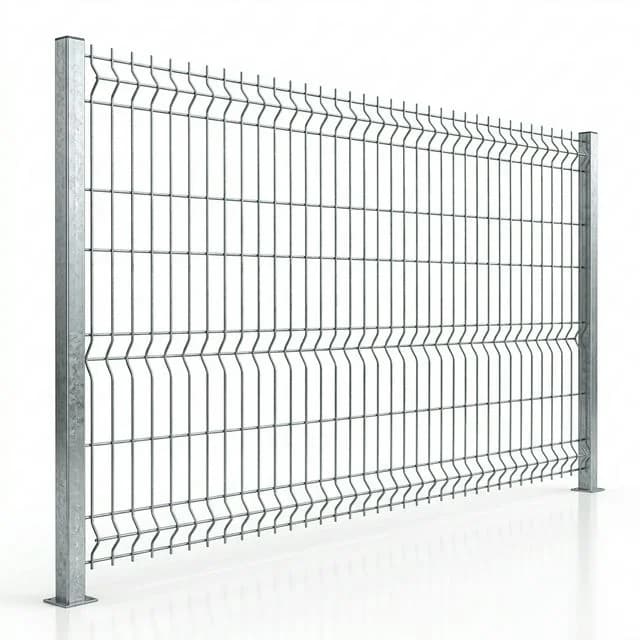
Catalog example of galvanized mesh and posts. This photograph does not identify the coating sequence, thickness, or certification of a temporary-panel order.
2. Microscopic Metallurgy: What the Bond Does and Does Not Prove
Batch galvanizing can form iron-zinc alloy layers beneath an outer zinc-rich surface. Their proportions and appearance vary with steel chemistry and processing. A hardness value for one layer cannot establish the impact resistance or usable rental life of a complete panel.
For procurement, the practical question is whether protection continues across the joints that will experience water retention and handling damage. A coating can be metallurgically bonded and still be damaged by bending, grinding, or severe impact. Conversely, a properly specified repair system should not be dismissed solely because it is paint.
Visual 1: Where to Inspect the Finished Panel
The diagram identifies inspection locations. It does not show an inevitable failure on either side or replace coating measurements on actual supplied panels.
3. Standards Decoding: ASTM A123 vs. ISO 1461 vs. Continuous Mill Specs
Specify the coating route on the finished assembly, then identify the applicable standard and edition. Do not accept an incoming-material certificate as proof that subsequent welds meet a finished-panel requirement.
ISO 1461:2022 concerns batch-dipped fabricated articles. Its scope excludes continuously galvanized sheet, wire and mesh, automatically galvanized tube and pipe, and certain products with dedicated standards. ASTM A123/A123M is another specification commonly used for batch galvanizing. The two standards have different classification and acceptance rules; their thickness tables are not interchangeable.
| Procurement question | Pre-galvanized panel | Galvanized after fabrication |
|---|---|---|
| When is zinc applied? | Before panel assembly | After the specified fabrication |
| What protects the completed weld? | The documented weld treatment | Zinc coverage from the batch process, subject to inspection |
| What certificate is relevant? | Incoming coating plus finished-weld treatment records | Galvanizing report traceable to the completed assembly |
| What establishes thickness? | Component coating designation and measurements | Applicable material category, steel thickness, and acceptance rules |
| Are tube interiors protected? | Depends on the tube product and process | Depends on cleaning access, venting, and drainage |
| What happens after cutting or drilling? | New exposed areas require assessment | New exposed areas require assessment |
| What affects handling performance? | Steel design, coating, repairs, and loading practices | Steel design, coating, repairs, and loading practices |
| What predicts rental economics? | Actual maintenance and replacement records | Actual maintenance and replacement records |
Minimum Coating Thickness by Component: Avoid a Single Panel-Wide Number
The following selected ASTM A123-24 Table 1 examples are reported in the American Galvanizers Association's 2024 revision explanation. Values are minimum average coating grades, expressed in microns; they are not individual spot-reading thresholds.
| Material category | Measured steel thickness | Coating grade / µm |
|---|---|---|
| Pipe and tubing | Below 1.6 mm | 45 |
| Pipe and tubing | Above 1.6 and below 3.2 mm | 45 |
| Pipe and tubing | Above 3.2 and below 4.8 mm | 75 |
| Wire | Below 1.6 mm | 35 |
| Wire | Above 1.6 and below 3.2 mm | 50 |
| Wire | Above 3.2 and below 4.8 mm | 60 |
These examples avoid exact thickness boundaries. At a boundary, consult the specified standard's full table and unit rules. Select the actual material category and measured thickness; then apply its sampling and specimen requirements. For ISO 1461 orders, obtain its own applicable local and mean requirements rather than copying these ASTM numbers.
Ask the inspector to record frame and mesh separately. A thick frame reading cannot compensate for deficient mesh or an uncoated joint. For duplex coatings, also distinguish the zinc layer from the overlying polymer; a total thickness reading alone does not establish zinc compliance.
4. Atmospheric Corrosivity and Service-Life Limits
ISO 9223:2012 classifies atmospheric corrosivity using first-year corrosion loss and environmental factors including humidity, sulfur dioxide, and airborne salts. A coastal address or an "urban" label alone does not establish the exposure of every panel in a rental fleet.
Track the conditions the asset actually encounters: wet stacking in the yard, road salts during transport, soil contact at lower rails, repeated loading damage, and time spent at exposed sites. Atmospheric categories do not automatically describe immersion, marine splash, or specialized chemical exposure.
A simple inventory calculation can illustrate why coating thickness matters:
Illustrative remaining zinc = starting thickness - assumed constant loss rate × time
Example only: 65 µm - (3 µm/year × 10 years) = 35 µm remaining
Example only: 15 µm - (3 µm/year × 5 years) = 0 µm remaining
The 15 µm and 65 µm starting values are comparison inputs, not universal pre-galv and batch-HDG specifications. The 3 µm/year rate is an assumed constant for arithmetic, not a measured site result. These calculations omit changing corrosion rates, localized weld defects, repairs, and mechanical damage. They cannot establish time to first red rust, structural failure, or an asset's usable hire life.
For a mixed fleet, group inspection records by exposure history and panel specification. Record the location and extent of corrosion, any broken welds, repair hours, and the reason for retirement. This produces more useful purchasing evidence than converting a generic atmospheric table into a guaranteed replacement date.
5. Weld-Seam Failure Analysis and Repair Requirements
When rust first appears at a joint, investigate coating continuity and water retention before concluding that every panel in the batch has the same defect. Corrosion, fatigue, inadequate weld formation, and mechanical overload can coexist, but they require different corrective actions.
For repair work, request the named coating product, surface preparation, required dry-film thickness, application conditions, and curing procedure. ASTM A780/A780M addresses repair of damaged or uncoated areas of hot-dip galvanizing; citing it does not establish that an entire pre-galvanized welded assembly meets ASTM A123. Repair acceptance also depends on the governing product specification and purchase agreement.
Do not treat a universal repair-area percentage or a single maximum patch size as valid for every standard and inspection stage. Identify whether the repair occurs at the galvanizing facility before acceptance or after transport and service damage. Record the affected area and obtain the acceptance basis from the responsible inspector.
A practical defect record contains a panel identifier, joint photograph, coating readings around the defect, repair method, and final disposition. Repairing surface protection cannot restore a structurally failed weld. Quarantine panels with broken wires, cracked frame joints, or uncertain integrity until assessed against the intended use.
6. Worked 5-Year Fleet TCO Model: 500-Panel Rental Fleet
This is a hypothetical budgeting worksheet, not a measured case study, market price survey, or prediction of either coating's failure rate. All figures are illustrative US-dollar inputs. Replace them with delivered quotations and your yard's records before choosing a supplier.
Baseline Model Assumptions
- Maintain 500 serviceable panels over five years, replacing retired panels as necessary.
- Use illustrative delivered unit costs of $24.50 for pre-galv and $31.50 for batch HDG. These are placeholders, not current offers.
- Assume total coating-related repair labor of 240 hours and 60 hours respectively, at $28/hour across the entire period.
- Assume 100 and 40 replacement purchases respectively over five years, priced at the same unit costs. These counts are scenario inputs, not industry scrap rates.
- Assume 500 remaining panels can be sold for $6 and $8 each respectively at the end. This residual value requires a real resale assessment.
- Assume equal 70% billable utilization: 500 panels × 60 months × 0.70 = 21,000 billable panel-months for each fleet. Repairs and replacements must support this availability assumption.
5-Year Financial Model Breakdown
| Cost component | Pre-galvanized scenario | Batch HDG scenario |
|---|---|---|
| Initial 500 panels | $12,250 | $15,750 |
| Repair labor: 240 / 60 hours × $28 | $6,720 | $1,680 |
| Repair consumables, five-year allowance | $600 | $200 |
| Replacements: 100 × $24.50 / 40 × $31.50 | $2,450 | $1,260 |
| Less residual value: 500 × $6 / 500 × $8 | −$3,000 | −$4,000 |
| Net five-year ownership cost | $19,020 | $14,890 |
| Cost per billable panel-month | $0.91 | $0.71 |
Formula: TCO = initial purchase + repair labor + consumables + replacements − residual value. Divide the result by billable panel-months, not by the number of deployments. One panel-month means one panel earning hire revenue for one month.
Under these assumptions, HDG costs $3,500 more initially and $4,130 less over five years, a 21.7% reduction relative to the pre-galv scenario. This advantage comes from the chosen repair, replacement, and resale inputs; it is not established by the standards cited in this article.
Sensitivity: When the Premium Does Not Pay Back
The assumed non-purchase cost advantage is $7,630 across the fleet. It supports an initial premium up to $15.26 per panel before modeled ownership costs become equal, holding all other inputs fixed. Recalculate when the proposed unit price or replacement costs change.
If both coating options instead incur the same total repair, replacement, consumable, and residual costs, the $3,500 initial premium remains an additional cost. Short holding periods, light exposure, or damage dominated by vehicle impacts may reduce the financial value of extra zinc protection.
This worksheet excludes financing, inflation, tax treatment, storage, transport between sites, common cleaning, customer credits, and revenue differences. Add these where they differ materially. If one fleet has lower availability, use its own billable denominator and include downtime effects. Avoid counting lost hire revenue twice as both a cost and a reduction in utilization.
For comparable proposals, send your panel specification and cost assumptions and request separate pricing for the coating routes, including delivery basis and inspection evidence.
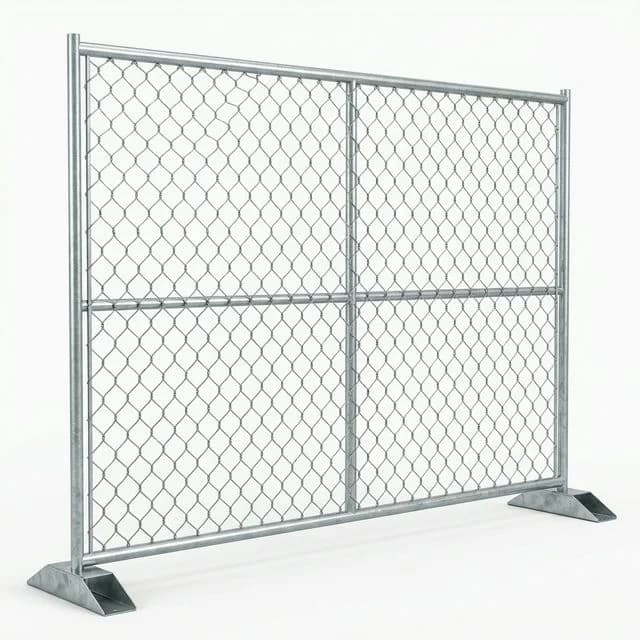
Catalog example of a temporary panel configuration. The image is not evidence of the modeled fleet's costs or coating performance.
7. Salt Spray Testing Reality: ASTM B117 vs. Natural Exposure
Salt spray results need a defined test method, specimen, exposure duration, and acceptance criterion. A report for an unwelded tube coupon does not establish the performance of a completed panel's joints. Likewise, two reports using different edge sealing, preparation, or failure definitions cannot support a simple ranking.
Ask whether the tested specimen includes representative wire-to-wire and wire-to-frame welds, the actual repair coating, and any duplex finish. The report should identify the tested product and show observations or photographs at the stated inspection intervals. Distinguish white zinc corrosion products from red steel rust.
Do not convert salt spray hours into outdoor years. The chamber environment differs from changing outdoor wetting and drying conditions, and mechanical handling is a separate load. Neither ASTM A123 nor ISO 1461 by itself establishes a universal "750-hour" fence requirement. If accelerated testing is required by a project, agree the protocol, acceptance criteria, laboratory, and production-lot relevance before ordering.
8. Duplex Coating Systems: When Powder Coating Over HDG Makes Sense
A duplex system combines galvanizing with an additional paint or powder layer. It may suit projects with color, appearance, or additional barrier requirements. Its usefulness depends on preparation, coating compatibility, curing, and subsequent handling; an added layer is not an automatic service-life multiplier.
Specify the zinc system and the powder system separately. Ask the finisher how it prepares the galvanized surface, manages outgassing where needed, and confirms adhesion and cure. Do not apply a universal preheat temperature or powder thickness without the coating manufacturer's instructions and process qualification.
For a rental operation, compare repairability as well as initial appearance. Colored panels can require cosmetic repair even when the underlying steel remains protected. Obtain an approved appearance sample, handling instructions, and a repair method for both layers. Test clamp fit and stacking contact points on the finished sample before accepting a large batch.
9. B2B Factory Acceptance and Procurement Inspection Checklist
Agree the inspection plan before production and payment milestones. Sampling size and acceptance criteria must follow the contracted specification and lot definition; the following checklist is a purchasing aid, not a substitute sampling standard.
- Identify the assembly: Confirm panel drawing, tube wall thickness, wire diameter, weld arrangement, and coating route for frame, mesh, bases, and hardware.
- Check traceability: Connect the finished-panel batch to its galvanizing report or incoming coating and weld-treatment records. A steel mill certificate alone is insufficient.
- Set component requirements: Name the standard and edition, applicable material categories, coating values, sampling plan, and repair acceptance basis.
- Measure correctly: Use a calibrated gauge suitable for non-magnetic coatings on steel and for the tube curvature or wire diameter. Keep frame, mesh, and repaired-area results distinguishable.
- Inspect joints: Check representative weld intersections, frame corners, cut ends, and later modifications for exposed steel, poor coverage, or unresolved defects.
- Review hollow sections: Confirm venting and drainage details with the galvanizer. Use agreed internal inspection access where coverage must be verified; a visible hole alone proves little.
- Check safe handling and fit: Look for sharp zinc projections, blocked connections, distortion, damaged wire, and clamp interference. Confirm panels fit the specified feet and couplers.
- Assess storage condition: Record wet bundles, heavy deposits, staining, or pitting. Dry and separate affected bundles and obtain a coating assessment before prescribing cleaning or recoating.
- Match hardware evidence: Specify the finish and corrosion protection of clamps, bolts, and bases separately. Coating thickness and thread fit depend on the actual hardware specification.
- Document disposition: Record accepted panels, permitted repairs, rejected items, photographs, readings, inspector identity, and responsibility for corrective work.
For Australian projects, review the system-level requirements in the AS 4687 temporary fencing and hoardings guide. A galvanizing certificate alone does not demonstrate compliance of the installed fence with stability, access, or loading requirements.
10. Frequently Asked Questions (FAQ)
Can you visually distinguish batch HDG from pre-galvanized fencing?
Appearance can suggest where to inspect, but it is not conclusive. Bright, dull, smooth, or mottled finishes can occur for several reasons. Ask for the manufacturing sequence, traceable records, and coating measurements. Photographs alone cannot certify either process.
Why might a new panel rust first at a weld?
Welding may damage an earlier zinc coating, and poor preparation or incomplete repair can leave steel exposed. Joints can also retain moisture or suffer handling damage. Inspect the particular defect rather than assuming a fixed failure time for all pre-galvanized panels.
Can galvanizing after fabrication distort thin-wall panels?
Thermal processing can release fabrication stresses and change panel geometry. Have the fabricator and galvanizer review the design, weld sequence, venting, and drainage. Agree dimensional tolerances and qualify a representative finished sample. There is no universal minimum tube wall that guarantees freedom from distortion.
Does white rust mean the panel must be scrapped?
Not necessarily. Light wet storage stain and severe coating consumption require different responses. Separate and dry wet bundles, assess the remaining coating and any pitting, and follow an agreed cleaning or repair procedure. Appearance alone does not establish remaining protection; avoid indiscriminate acid cleaning.
How much thicker is batch HDG than pre-galvanizing?
There is no universal ratio. Compare the actual component specifications and measured zinc thickness. Sheet coating masses can describe the combined coating on both faces, so do not compare them directly with a one-surface micron reading without checking the designation and conversion basis.
Is powder coating over pre-galvanized steel equivalent to powder over batch HDG?
It is a different coating system. Compare protection at completed welds, preparation, adhesion, damage tolerance, and repair requirements. Powder coating can add a barrier, but it does not prove that zinc is present beneath every joint or eliminate the need for qualification.
Can a supplier combine pre-galvanized frames with separately galvanized mesh?
Yes, but identify how the components are joined and how any damaged coating is restored. Welded and mechanically attached assemblies present different details. Accept the finished configuration against its agreed specification rather than assuming mixed coating routes are automatically adequate or inadequate.
Does a dark gray galvanized finish indicate poor quality?
Color alone is not an acceptance test. Steel chemistry and processing can influence appearance and thickness. Check the specified coating, adherence, finish, and intended use. Agree extra cosmetic requirements before production if a uniform appearance matters to your customers.
11. Authoritative Sources and Reference Documentation
Sources checked for this review on November 10, 2026:
- ISO 1461:2022 — Hot dip galvanized coatings on fabricated iron and steel articles: Official scope and exclusions for batch galvanizing. The full standard governs contractual acceptance; the public abstract is not its complete inspection procedure.
- ISO 9223:2012 — Corrosivity of atmospheres: Official explanation of atmospheric classification and first-year corrosion assessment. It does not establish a guaranteed rental-panel service life.
- American Galvanizers Association — 2024 Revision of ASTM A123: Technical explanation including the material-category coating table used for the selected examples above. Consult the specified standard for complete acceptance rules.
Other standards named in this guide identify specification or testing topics; their full procedures are not reproduced here. None of these sources supplies the hypothetical fleet's prices, repair hours, replacement counts, or resale values. No physical panel testing or customer fleet study is reported in this article.
Commercial Procurement and Container RFQ Support
Planning a fleet replenishment or a project order? Review temporary fence panels with matching fence bases and feet and fence clamps and couplers, then send a technical RFQ.
Include the destination, quantity, panel dimensions, tube and wire sizes, expected exposure, intended holding period, coating route, and required standard edition. Request the available inspection records, delivery basis, packaging method, and a representative sample where needed. Use the same requirements for each supplier so that differences in quoted price correspond to identifiable differences in specification and evidence.
Author

Categories
More Posts
Acoustic Barriers on Temporary Fencing: Wind Loads & Noise Compliance Guide
Learn how attaching acoustic blankets to temporary fence panels impacts wind loading, structural stability, and noise compliance for urban construction sites.

The Ultimate Deep-Dive: How to Choose Temporary Fence Panels for Wholesale & Construction Sites
A comprehensive, technical guide for procurement managers on selecting temporary fence panels. We cover tube thickness, galvanizing standards, and 40HQ container loading optimization.

Temporary Fence Feet & Bases: Concrete-Filled Plastic vs. Recycled Rubber vs. Steel Plate — Ballast Engineering, Trip Hazard Compliance, and Fleet Procurement Guide
Compare temporary fence feet in concrete-filled plastic, rubber and steel. Check ballast, access risks and fleet costs, then prepare a useful procurement RFQ.