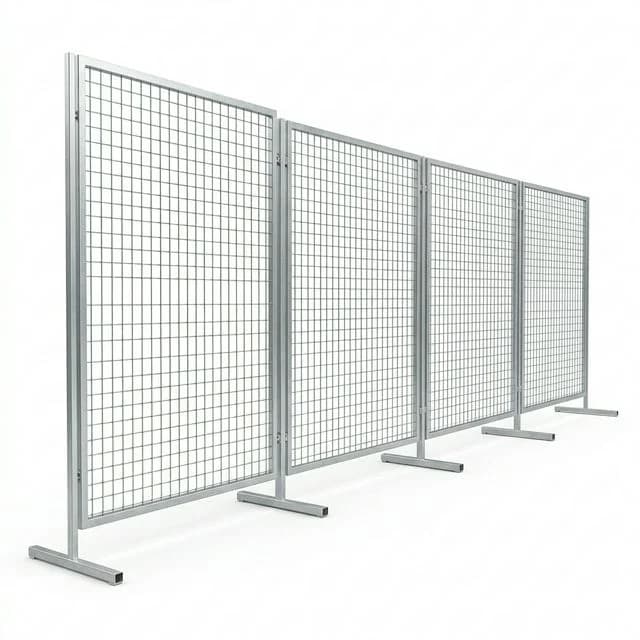
The Engineer's Guide to Integrating Solar CCTV and Smart Security on Temporary Fences
Engineer solar CCTV on temporary fence panels with EPA, ballast, bracing, false-alarm controls, and procurement checks before mounting cameras safely.
The Engineer's Guide to Integrating Solar CCTV and Smart Security on Temporary Fences
As construction sites and remote industrial projects increasingly rely on autonomous AI surveillance, site managers face a critical integration challenge. Sourcing a standard perimeter fence is straightforward, but clamping heavy solar-powered CCTV units, battery enclosures, and IoT sensors directly to those lightweight panels introduces severe structural and operational liabilities.
A standard temporary fence panel is engineered to support its own weight and an open mesh wind load. When procurement teams treat security hardware as a "bolt-on" afterthought without engineering oversight, they trigger two catastrophic outcomes: wind-induced blowovers and chronic false alarms due to structural vibration.
In this guide, we break down the engineering mechanics of Effective Projected Area (EPA), the causes of pixel-based motion false alarms, and how to specify the correct temporary fencing system for smart perimeter integration.
Publication date and scope: Published July 20, 2026. This guide is for global temporary fence procurement and pre-engineering review. It does not replace a site-specific stamped design, local wind-loading code, or authority-having-jurisdiction approval. Treat ASCE 7-22 and IBC 3103 as source examples, then apply the local standard that governs your project.
1. The Hidden Danger of EPA (Effective Projected Area)
When you mount a solar panel, a PTZ (Pan-Tilt-Zoom) camera, and a NEMA-rated battery box to the top rail of a temporary fence, you are fundamentally altering the structure's aerodynamics and center of gravity.
Engineers calculate this using the Effective Projected Area (EPA). The EPA is the true surface area of the equipment that resists the wind, multiplied by its drag coefficient. While the welded mesh of a standard temporary fence panel allows 85% of wind to pass through harmlessly, a solid solar panel acts as a perfect sail.
Because this sail is mounted at the highest point of the fence (the apex), it acts as a lever arm. The force of the wind on the solar panel creates a massive overturning moment, easily overcoming the restoring moment provided by standard 60lb (28kg) concrete-filled fence bases. Under a moderate 35 mph wind gust, an improperly anchored system will experience a domino-effect collapse.
Minimum engineering handoff before approval
Do not release a purchase order for fence-mounted solar CCTV until the supplier, installer, or project engineer can show a one-page load handoff:
- Equipment schedule: solar panel, camera, battery box, antenna, and bracket dimensions, weights, and mounting heights.
- EPA summary: projected area times drag coefficient for each solid component, separated from the open mesh panel area.
- Design wind case: project wind speed, exposure category, gust factor assumptions, and whether temporary-service reductions are allowed locally.
- Overturning check: wind force times mounting height compared with resisting moment from ballast, ground anchors, or barrier weight.
- Operational limit: a documented wind-speed trigger for removing solar assemblies, adding ballast, or laying the fence flat.
If the project team cannot provide these five items, use an independent mobile CCTV tower or earth-anchored base instead of direct frame clamping.
2. Vibration and the "False Alarm" Epidemic
Beyond physical collapse, mounting cameras to temporary fences severely degrades security performance. Temporary fencing is designed to be modular and lightweight; consequently, the mesh and frame vibrate when subjected to wind or traffic.
If you deploy basic pixel-based motion detection cameras on a vibrating fence, the camera software perceives the shaking background as movement. This generates thousands of nuisance alarms, leading monitoring stations to either ignore alerts from the site or disable the system entirely.
Resolving Camera False Alarms:
- Decoupled Mounting: Whenever possible, mount high-value PTZ cameras on independent, ballasted towers positioned directly behind the fence line.
- AI-Based Analytics: Transition from pixel-based motion sensors to edge-AI cameras configured for "Human/Vehicle" detection, filtering out swaying mesh and moving foliage.
- Vibration Dampeners: Use Sorbothane gel pads or heavy-duty rubber isolators between the camera bracket and the steel fence post.
3. Structural Solutions: Comparing CCTV Integration Methods
For sites that absolutely must mount hardware directly to the perimeter line, procurement teams must step away from standard panel specifications and upgrade the structural system.
| Integration Method | Structural Modification Required | Primary Advantage | Operational Risk / Disadvantage | Wind Resistance | Cost Profile |
|---|---|---|---|---|---|
| Direct Frame Clamping | V-bracing on panel; 100lb+ ballast | Low initial cost; uses existing fence. | High vibration; extreme wind hazard. | Poor | $ |
| Integrated Camera Post | Heavier gauge tubular post replacing standard coupler | Reduces panel stress; cleaner cabling. | Post base still relies on surface friction. | Moderate | $$ |
| Independent Mobile Tower | None (stands behind the fence) | Zero vibration transfer; massive stability. | Requires site footprint inside perimeter. | Excellent | $$$ |
| Sensor Fusion (Cable) | Fiber-optic cable tied to mesh | Uses fence movement as the sensor itself. | Requires PTZ camera elsewhere to verify. | N/A | $$$ |
| Earth-Anchored Base | Ground stakes driven through base blocks | Near-permanent stability for high EPA loads. | Damages asphalt; hard to relocate. | Excellent | $$ |
| Water-Filled Jersey Barriers | Mesh panels slotted into heavy barriers | Immense weight stops tipping and sliding. | Large footprint; requires water logistics. | Very High | $$$ |
For projects where the camera must stay on the fence line, share the equipment schedule and site exposure with our team before ordering panels. We can map the load case to the right temporary fence panels, bracing, bases, and couplers.
4. Procurement & Engineering Checklist for Smart Perimeters
Before your site superintendent approves a purchase order integrating security tech with temporary fencing, ensure this checklist is completed:
- 1. EPA Calculation: Has the Effective Projected Area of the solar panel, camera, and battery box been calculated?
- 2. Wall Thickness Upgrade: Are the supporting fence panels manufactured with a minimum 1.5mm to 2.0mm tube wall thickness to prevent buckling at the clamp point?
- 3. V-Bracing Deployment: Is the fence line equipped with diagonal V-bracing at the exact panel where the camera is mounted, plus adjacent panels?
- 4. Ballast Upgrades: Has standard 60lb basing been doubled, or replaced with high-friction heavy rubber / water-filled bases?
- 5. Coupler Integrity: Are you using heavy-duty, hot-dipped galvanized steel clamps (not lightweight pressed metal) to prevent the frame from twisting?
- 6. Vibration Isolation: Are rubber isolator pads specified between the camera mount and the steel tube?
- 7. Operational Laydown Protocol: Does the site have a clear wind-speed threshold (e.g., 35 mph) where solar units are removed or the fence is laid flat?
5. Frequently Asked Questions (FAQ)
Q: Can we attach standard privacy screens to a fence that also holds a solar camera? A: Combining privacy mesh (which acts as a sail) with the high EPA of a solar camera creates an extreme wind-load risk. If both are required, the fence must be treated as a semi-permanent hoarding with deep ground anchors or massive concrete ballast.
Q: Are there building codes regulating temporary fences with cameras? A: While there is no single "temporary camera fence" code, engineers routinely refer to IBC Section 3103 (Temporary Structures) and ASCE 7-22 to calculate baseline wind loads. Failure to account for the increased sail area exposes the contractor to severe liability if a blowover causes injury.
Q: Why is my fence-mounted camera triggering false alarms on perfectly clear days? A: Small, imperceptible vibrations caused by heavy trucks passing nearby or natural ground resonance travel up the steel frame. At 30x optical zoom, a 1-millimeter vibration at the mount translates to violent shaking on the camera feed.
References and Further Reading
For engineers and procurement officers drafting compliance documents, the following resources provide the foundational data for wind load calculations and perimeter security standards:
- ASCE 7-22 Minimum Design Loads: The definitive standard for determining wind forces on structures.
- IBC Section 3103 (Temporary Structures): Legal and safety baseline requirements for structures deployed for under 180 days.
- SIA (Security Industry Association) Guidelines: Best practices for integrating AI video analytics and minimizing nuisance alarms in perimeter applications.
Conclusion
A successful smart perimeter requires treating the temporary fence and the security hardware as a single, engineered system. Slapping expensive AI cameras onto entry-level mesh panels is a recipe for false alarms and structural failure.
At Temp Fence Panels, we manufacture heavy-gauge, wind-resistant temporary fencing and heavy-duty bracing systems specifically designed to support the rigorous demands of modern solar CCTV integration.
Don't leave your perimeter security to guesswork. Contact our engineering team today for a customized load consultation and ensure your next project stays upright, secure, and compliant.
Author

Categories
More Posts

B2B Compliance: Temporary Fencing Regulations, AS 4687, and Safety Requirements
A professional checklist of global temporary fencing codes (AS 4687, OSHA). We explain site compliance, anti-climb aperture sizing, and wind load dynamics.

The Ultimate Deep-Dive: How to Choose Temporary Fence Panels for Wholesale & Construction Sites
A comprehensive, technical guide for procurement managers on selecting temporary fence panels. We cover tube thickness, galvanizing standards, and 40HQ container loading optimization.
Acoustic Barriers on Temporary Fencing: Wind Loads & Noise Compliance Guide
Learn how attaching acoustic blankets to temporary fence panels impacts wind loading, structural stability, and noise compliance for urban construction sites.