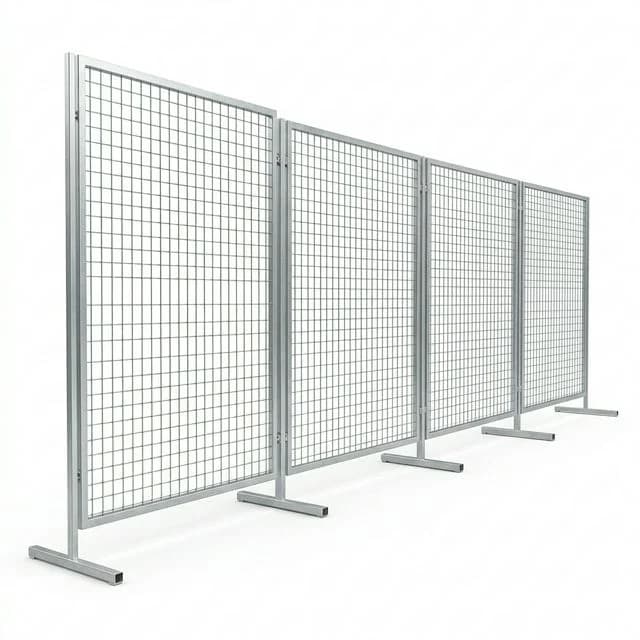
The Engineer’s Guide to Temporary Fence Wind Loading, Bracing, and Blowover Prevention
Use this temporary fence wind loading guide to compare privacy-screen sail effects, bracing, ballast, and blowover prevention checks before RFQ.
The Engineer’s Guide to Temporary Fence Wind Loading, Bracing, and Blowover Prevention
For construction site managers, civil engineers, and procurement teams, temporary fencing is often viewed as a simple perimeter commodity. However, when a severe storm hits, that "simple commodity" can quickly transform into a massive liability. A collapsed temporary fence line—commonly referred to as a "blowover"—not only leaves a secure site exposed to theft and vandalism, but it also poses a severe risk of property damage to adjacent vehicles and a catastrophic safety hazard to pedestrians.
The core issue is rarely the fence panel itself; it is the failure to account for aerodynamic forces, specifically wind loading, and the lack of proper structural bracing. When you add acoustic barriers, privacy screens, or corporate banner mesh to a fence line, you are essentially erecting a series of massive sails right at the edge of your construction site.
In this comprehensive engineering and procurement guide, we will break down the physics of temporary fence wind loading, explain how the "sail effect" changes structural requirements, evaluate different ballast and bracing systems, and provide a definitive checklist for procuring and installing high-wind fencing solutions.
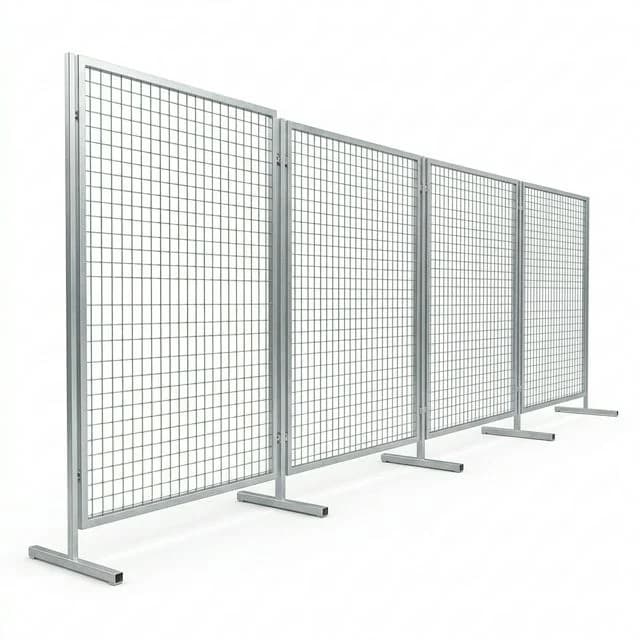
Scope and update note: Updated June 24, 2026. This global guide applies to surface-mounted temporary fence panels used around construction sites, events, civil works, and industrial perimeters. It is a procurement and engineering-screening guide, not a stamped structural design; final bracing, anchorage, and laydown procedures must follow the governing local code, supplier test evidence, and a qualified engineer where wind exposure, screens, public access, or long duration raise the consequence of failure.
If you are already writing an RFQ, compare the baseline temporary fence panel system, fence bases and feet, clamps and couplers, and temporary fence bracing options before treating a screened fence line as a standard panel order.
1. The Physics of a Blowover: Understanding Wind Load on Temporary Structures
To prevent a fence from blowing over, you must first understand the forces acting upon it. Unlike permanent fencing, which relies on posts concreted deep into the ground to resist lateral forces, temporary fencing relies almost entirely on its surface footprint, base weights, and supplementary bracing to counteract the overturning moment.
The Overturning Moment
When wind hits a vertical fence panel, it exerts a horizontal force. The center of this pressure acts roughly at the midpoint of the panel's height. The "overturning moment" is the rotational force attempting to push the panel over its pivot point (the edge of the base foot).
If the overturning moment created by the wind exceeds the restoring moment (the downward gravitational force provided by the weight of the panel, the base blocks, and any attached bracing), the fence will collapse.
Calculating the Wind Pressure
Wind pressure is not linear; it is exponential. The fundamental formula for wind pressure ($P$) is derived from the velocity of the wind ($V$). According to standard aerodynamic principles (and mirrored in codes like ASCE 7), wind pressure increases with the square of the wind speed.
This means that a wind gust of 60 mph does not apply 20% more force than a 50 mph gust; it applies 44% more force.
This non-linear reality is why standard ballast configurations that survive everyday breezes fail catastrophically during localized storm microbursts. Furthermore, the wind load is affected by the terrain category. A fence installed in a wide-open field (Category C) will experience significantly higher wind loads than the same fence installed in a dense urban environment (Category B) where surrounding buildings disrupt the airflow.
2. The "Sail Effect": How Privacy Screens Radically Change the Math
One of the most frequent mistakes made on construction sites is the assumption that a temporary fence setup that is stable in its "open mesh" configuration will remain stable once covered in privacy screen (shade cloth) or advertising banners.
This brings us to the concept of the Solidity Ratio.
The solidity ratio is the percentage of the fence's surface area that blocks the wind.
- A standard anti-climb welded wire mesh panel has a very low solidity ratio (typically around 10% to 15%). The wind blows straight through the apertures.
- A standard privacy screen has a solidity ratio of 50% to 70%.
- A heavy-duty acoustic curtain or a fully printed vinyl banner has a solidity ratio nearing 100%.
When you install a 100% solid banner on a standard 6x8 ft (or 2.1x2.4m) temporary fence panel, you are creating an impermeable sail. The wind load on that panel increases by an order of magnitude. If the base weights are not drastically increased, or if structural bracing is not added, a blowover is virtually guaranteed even in moderate wind conditions.
Impact of Solidity Ratio on Structural Wind Load
| Configuration | Estimated Solidity Ratio | Wind Drag Coefficient Factor | Baseline Wind Resistance Before Tipping | Required Intervention |
|---|---|---|---|---|
| Bare Welded Mesh Panel | ~10 - 15% | Very Low (0.2) | Capable of withstanding moderate gusts with standard 60lb/28kg bases. | Standard base weights. Routine clamp checks. |
| Open Mesh with Small Logo Banners | ~20 - 35% | Low to Medium (0.4 - 0.7) | Usually manageable on sheltered runs, but corner panels and gate bays become the weak points. | Add extra ballast at gates, corners, and straight-run ends. |
| Perforated Printed Mesh | ~35 - 50% | Medium (0.7 - 0.9) | Material may be sold as "breathable" while still creating a meaningful sail area. | Confirm open-area percentage and tighten brace spacing before approval. |
| Standard Shade Cloth (50%) | ~50% | Medium (0.8 - 1.0) | High risk of tipping in gusts over 25-30 mph. | Double basing required. Diagonal bracing recommended every 3 panels. |
| Thick Privacy Mesh (70%+) | ~70 - 85% | High (1.2) | Extreme risk of tipping in moderate winds. | Mandatory V-bracing. Heavy block weights (100lb+) required. |
| Solid Vinyl / Acoustic Barrier | ~100% | Severe (1.4 - 1.6+) | Acts as a solid sail and should not be treated as a standard temporary-fence setup. | Ground anchors, engineered V-bracing, or a permanent-fence design basis. |
Note: The above values are approximations. Always consult a structural engineer for site-specific calculations based on local building codes.
3. Core Bracing and Ballast Systems for Wind Mitigation
Procurement teams must view temporary fencing not as a single SKU (the panel), but as a system (Panel + Coupler + Base + Bracing). To mitigate the risk of blowovers, you have three primary engineering levers to pull:
A. Increasing Surface Ballast (Deadweight)
The simplest way to increase the restoring moment is to make the base heavier.
- Concrete-Filled Plastic Bases: The industry standard. A typical high-visibility plastic shell filled with concrete weighs roughly 28kg (60 lbs). In high wind areas, stacking two blocks per joint is a common first-line defense.
- Solid Rubber Bases: Often made from recycled tires, these provide excellent friction on asphalt, preventing the fence from sliding laterally before it tips.
- Water-Filled Barriers: While highly visible and heavy when full, they are prone to leaking or freezing. They are generally used for traffic control rather than standard perimeter fencing, but some systems integrate mesh panels into water-filled bases for high-wind stability.
B. Diagonal and V-Bracing
When adding weight to the bottom of the panel is insufficient (especially when dealing with high solidity ratios), you must widen the footprint of the fence. This is achieved using bracing.
- Diagonal Bracing: A steel tube attached to the top or middle of the fence panel, angled down to the ground behind the fence, and anchored into a separate base block. This acts as a strut, directly resisting the overturning force.
- V-Bracing: A more robust system where two braces form a "V" shape, offering stability against wind coming from multiple directions.
- Placement Frequency: In highly exposed areas, it is common to require a diagonal brace on every third panel. If 100% solid banners are used, you may require bracing on every single panel.
C. Ground Anchoring
When surface weights fail to provide adequate safety margins, the fencing must be tethered to the earth.
- Earth Anchors / Star Pickets: Steel stakes driven deeply into the soil and bolted to the base of the fence panel.
- Mechanical Anchors into Concrete: If the fence is erected on a concrete slab or asphalt roadway, mechanical expansion bolts can be driven through the fence bases directly into the substrate. This provides near-permanent stability but damages the surface.
For Australian-style temporary fencing and hoarding projects, use the AS 4687 temporary fencing and hoardings pathway as a standards-mapping checkpoint before procurement freeze. For non-Australian projects, treat it as a useful comparison framework only and map the assumptions back to the governing jurisdiction.
4. Application Boundaries: When Surface Weights Fail
It is critical for engineers and procurement officers to recognize the physical limits of temporary surface-mounted fencing.
Boundary 1: Extreme Weather Events If your site is in a hurricane zone, a cyclone region, or an area subject to extreme coastal gales, standard temporary fencing with surface weights is mathematically inadequate. During severe weather warnings, the only safe protocol is a "controlled laydown"—where site crews preemptively detach the panels from the bases and lay them flat on the ground until the storm passes.
Boundary 2: Long-Term Hoarding If the temporary fence is expected to remain in place for over 12 months in an exposed area, and particularly if it will bear heavy advertising hoarding (plywood or solid metal sheeting), surface weights are not sufficient. The site requires semi-permanent timber or steel posts driven into the ground.
5. Procurement Strategy: Specifying Wind-Resistant Fences
When issuing a Purchase Order for a high-wind site, generic specifications will leave you exposed. You must mandate strict mechanical tolerances.
- Tube Wall Thickness: Do not accept 1.2mm wall thickness for high-wind zones. The panels will buckle at the clamp points under extreme wind load. Specify a minimum of 1.5mm to 2.0mm outer frame wall thickness.
- Coupler (Clamp) Integrity: The fence is only as strong as its weakest link. Flimsy pressed-metal clamps will snap, causing a domino effect down the fence line. Specify heavy-duty, hot-dipped galvanized steel clamps with minimum 8mm thick bolts.
- Anti-Lift Brackets: In extreme winds, the panels can actually lift vertically out of their base holes before tipping. Specify bases with anti-lift locking mechanisms or utilize specialized retaining brackets.
- Weld Quality: Specify 360-degree hand-welded joints. Spot-welded mesh will shear off the frame under the sustained oscillating pressure of high winds.
For a quote package, require bidders to state the panel wall thickness, base mass, coupler type, brace spacing, screen solidity, and inspection/laydown trigger in one schedule. If a supplier cannot document these values, treat the offer as an incomplete wind-resistance package rather than a like-for-like low bid.
6. The 10-Point Engineering & Site Installation Checklist
Before signing off on a perimeter fence installation, site managers should run through this structural safety checklist:
- 1. Wind Zone Assessment: Has the local baseline wind speed and terrain category been established?
- 2. Solidity Ratio Check: Is the fence bare mesh, or will privacy/dust screens be added?
- 3. Ballast Verification: Are the base blocks the correct specified weight (e.g., minimum 28kg per block)?
- 4. Staggered Spacing: On long straight runs, has the fence been installed with a slight zig-zag or with perpendicular support panels to increase lateral stability?
- 5. Brace Frequency: Are diagonal braces installed at the correct intervals (e.g., every 3rd panel) as dictated by the screen solidity?
- 6. Brace Weighting: Do the diagonal braces have their own dedicated heavy ballast blocks at the ground contact point?
- 7. Clamp Tightness: Have all panel couplers been tightened with a power drill to prevent panel slipping?
- 8. Anti-Lift Verification: Are the panels seated deeply into the bases, and are anti-lift devices engaged if specified?
- 9. Gate Reinforcement: Are the hinge panels supporting pedestrian or vehicle gates double-braced to handle dynamic loads?
- 10. Extreme Weather Protocol: Is there a documented site procedure for laying down panels in the event of a severe weather warning?
7. Frequently Asked Questions (FAQ)
Q: Can I use sandbags instead of concrete blocks for fence weight? A: While sandbags add weight, they degrade quickly under UV exposure, split open, and freeze solid in winter. They should only be used as a temporary emergency measure, not as a primary engineering solution for wind resistance.
Q: How do privacy screens affect wind load compared to open mesh? A: An open welded mesh panel allows roughly 85% of the wind to pass through. Adding a standard privacy screen blocks 50% to 70% of the air, multiplying the overturning force by a factor of 3 to 5. Solid banners can increase the force by a factor of 10.
Q: What is AS 4687:2022? A: AS 4687:2022 is the Australian Standard for Temporary Fencing and Hoardings. It is globally recognized as one of the most rigorous testing frameworks for temporary fence stability, specifying exact testing protocols for wind resistance and overturning forces.
Q: If one panel blows over, will the rest follow? A: Yes. Because panels are clamped together, the failure of a single weak point (the "domino effect") transfers the overturning moment to the adjacent panels, often bringing down the entire line. This is why consistent bracing is vital.
8. References & Industry Standards
When calculating site-specific requirements, engineers should refer to the following authoritative guidelines:
- ASTM F3342-19, Standard Guide for Temporary Fence Applications: Flags screening as a wind-load redesign trigger and points users toward permanent-fence-style wind design when screens are installed.
- CLFMI Wind Load Guide WLG 2445, updated January 2023: Provides line-post wind-load methodology, exposure factors, mesh/fabric coefficients, and engineer-review disclaimers for chain-link fence systems.
- ASCE/SEI 7-22 Minimum Design Loads and Associated Criteria: The current ASCE loading standard used for wind, ice, seismic, flood, and other structural design loads.
- Temporary Works Forum Hoardings Guide, revised August 2020: Explains why temporary hoardings and solid barriers attract significant loads and require competent design and independent checking.
Conclusion: Don't Leave Perimeter Security to Chance
A temporary fence blowover is an entirely preventable failure. By understanding the physics of wind loading, acknowledging the massive impact of privacy screens, and procuring the correct bracing and heavy-duty panels, you can protect your site from liability, delays, and safety hazards.
At Temp Fence Panels, we engineer our products to survive the harshest environments. Our export team can assist you in configuring the exact combination of wall thickness, heavy-duty couplers, and V-bracing required for your specific wind zone.
Contact our engineering sales team today to request a customized load analysis and secure your construction site with confidence.
Author

Categories
More Posts

Beyond the Padlock: Tamper-Proof Clamps and Anti-Lift Brackets for Temporary Fencing
Use this 2026 guide to compare tamper-proof clamps, shear nuts, and anti-lift brackets for temporary fence panels before ordering high-security hardware.

The Procurement Choice: Crowd Control Barriers vs. Temporary Fence Panels
A B2B tactical guide on choosing between crowd control barriers and temporary fence panels. We evaluate deployment speed, ROI for rental fleets, and interlocking mechanisms.
March 2026 Update: U.S. Temporary Steel Fencing Duties From China and the April 9 Buying Window
The U.S. Commerce Department has issued final AD/CVD determinations on temporary steel fencing from China. This deep-dive translates the March 2026 decision into landed-cost, sourcing, scope, and compliance actions for contractors, rental fleets, and distributors.