
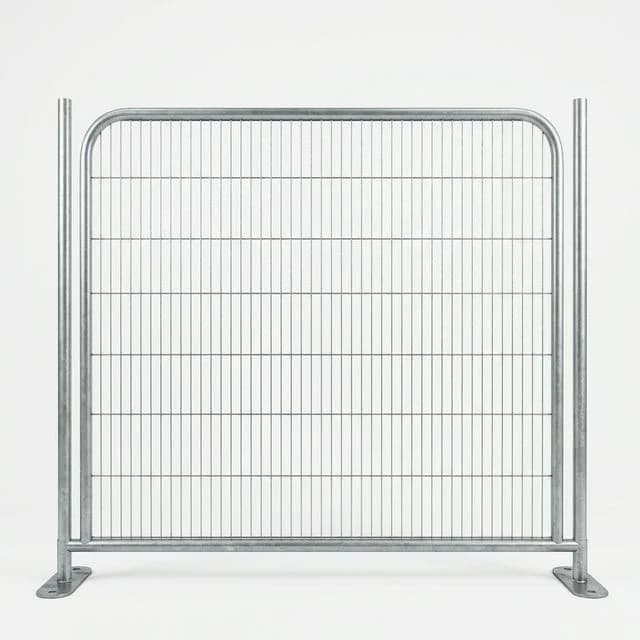
Round-Top vs. Square-Top Temporary Fence Panels: Weld Fatigue, Fleet Durability, and Total Cost of Ownership (TCO) Guide
Compare round-top vs square-top temporary fence panels: weld fatigue, handling risks, a worked TCO model, and an RFQ checklist. Plan your fleet purchase.
For temporary fencing hire companies, contractors, and equipment distributors, the useful question is whether round-top vs. square-top temporary fence panels changes repair effort and ownership cost under their own handling conditions. Dimensions, tube thickness, mesh attachment, coating and compatible accessories matter alongside crown shape.
Procurement answer: A continuous bent upper tube removes the two upper rail joints found in the square-top design compared here. That can remove a potential fatigue detail, but it does not establish a longer service life or lower TCO by itself. Prefer round-top where your damage records identify upper joints or corner snagging as a recurring cost; compare compliant square-top offers where those costs are low.
Reviewed: November 3, 2026. Scope: global procurement, with English-language engineering and buying guidance. This comparison assumes a welded square-top frame versus a continuous inverted-U round-top frame, each with a separate lower rail. Actual designs vary. No comparative fleet test data is supplied; prices, loss rates and repair costs in Section 5 are hypothetical inputs. Shape alone does not establish wind resistance, anti-climb performance or compliance in any jurisdiction.
For a supplier comparison, start with our temporary fence panels, fence clamps and couplers, and fence bases and feet. Request matching drawings before comparing quotes.
1. Structural Anatomy: Continuous Bent Tube vs. Welded Upper Joints
Square-Top Construction
The reference design uses two vertical tubes, a separate top rail and a bottom rail. Upper joints may be mitered, butted or saddled; the drawing determines their location and weld detail. Some designs have capped open tube ends, while others use closed joints. Welding creates a heat-affected zone, but that zone is not inherently brittle: material, heat input and joint quality affect the outcome.
Round-Top Construction
The reference design bends one tube into an inverted U, leaving no frame splice at the two upper corners. Mesh attachments and bottom-rail welds remain. Cold bending can introduce wall thinning, ovality and residual stresses, so bend quality still needs inspection. Do not infer uniform stress distribution, impact capacity or fatigue life from the curved outline.
Visual 1: Frame Joints and Inspection Locations
The schematic identifies inspection locations; it is not a stress analysis, load test or installation drawing.
2. Four Failure Modes to Check in Either Fleet
Failure Mode 1: Weld Fatigue from Repeated Loading
Transport vibration and repeated handling can impose cyclic loads. TWI explains that fatigue cracks can grow under repeated stresses and that weld flaws and weld-toe features can promote early cracking. Removing an upper joint removes that particular welded detail; lower joints, mesh connections and bent tube can still fail. This mechanism does not quantify a service-life advantage for either panel.
During return inspection, record the crack location, panel model, handling history and whether the panel was repaired or retired. Separate upper-joint fatigue from collision damage and theft before comparing fleet loss rates.
Failure Mode 2: Moisture Ingress and Internal Corrosion
If a design uses open-ended tubes, missing caps or defective seals can admit water. A continuous upper bend avoids those particular openings, but water can still enter through other holes or damaged joints. Internal zinc coverage is product-specific; an exterior coating description does not prove internal protection.
Inspect caps, coating breaks, lower tube ends and manufacturer-provided drainage paths. Do not drill new drainage holes without approval: hole locations affect tube strength and may also be part of the galvanizing process design.
Failure Mode 3: Snagging and Sharp Wire Ends
Protruding tube ends, weld spatter or detached wires can catch neighboring mesh during unstacking. Rounded corners may reduce some contact points, but neither shape eliminates cuts or snagging. Assess the complete panel, including mesh ends and lower rails, in its intended stillage.
Use a controlled sample loading and unloading trial to record snags, handling time and visible damage. Keep gloves, handling procedures and rack restraints in the comparison; do not turn the trial into an assumed injury-reduction percentage.
Failure Mode 4: Racking and Impact Damage
Either design can distort under asymmetric handling or vehicle impact. Tube section, weld quality, infill attachment and restraint determine the load path. A round upper frame is not a lifting point or a vehicle barrier.
Move panels using the supplier's approved rack and lifting method. Quarantine cracked, kinked or badly distorted panels rather than returning them to service because they can be made to look straight.
3. Manufacturing Processes: Assess Mesh Attachment Separately
Crown geometry does not determine whether mesh is attached by manual MIG welding, automated welding or a resistance-welding process. Either panel shape can have good or poor mesh retention. A trade name such as “SmartWeld” is not, by itself, a test result or a requirement of a cited standard.
Ask each supplier to identify the attachment method, which wire ends are connected, coating repair after welding, and the inspection method. Where strength is specified, request a report for the same tube, wire, joint and production configuration being offered. Compare the test method, load direction and acceptance criterion; do not substitute a mesh wire-intersection test for a wire-to-frame joint test.
4. Engineering & Commercial Comparison Matrix
Use this matrix to request comparable evidence, rather than ranking all round-top panels above all square-top panels.
| Evaluation Metric | Reference Square-Top Panel | Reference Continuous Round-Top Panel | What the Buyer Should Verify |
|---|---|---|---|
| Upper Frame Geometry | Separate top rail with two upper joints | Continuous bent upper tube | Drawing, bend radius and actual splice locations |
| Fatigue Inspection | Include upper rail weld details | Include bends as well as remaining welds | Matched cyclic test data or recorded fleet failure locations |
| Moisture Entry | Check caps or closures where present | No open tube ends at the upper bends | Other openings, internal coating and drainage design |
| Stillage Handling | Check corners, spatter and protruding ends | Check curved corners and all exposed wire ends | Controlled handling trial with the intended rack |
| Operator Safety | Sharp edges and damaged mesh remain hazards | Sharp edges and damaged mesh remain hazards | Edge finish, inspection and safe handling procedure |
| Mesh Retention | Attachment method varies by supplier | Attachment method varies by supplier | Wire-to-frame and wire-intersection test scope |
| Compliance | Shape does not establish compliance | Shape does not establish compliance | Applicable edition and reports for the complete offered system |
| Annual Replacement Rate | Must come from your records or a matched trial | Must come from your records or a matched trial | Keep repairs, irreparable damage and losses separate |
| Purchase and Lifecycle Cost | Use a current like-for-like landed quote | Use a current like-for-like landed quote | Include accessories, handling, repairs and residual value |
For related purchasing questions, see our anti-climb temporary fencing comparison and tamper-proof hardware guide. Verify site-specific requirements independently of the frame shape.
5. Visual 2: Worked 3-Year Total Cost of Ownership (TCO) Model
This hypothetical example shows how to compare offers; it is not a measured fleet case study, a market price survey or a supplier performance promise. The rates deliberately differ so that readers can see how strongly assumptions affect the result. Replace them with documented fleet records and current quotes.
Fleet Operating Assumptions
- Fleet size: 1,000 usable panels, maintained by replacing retired units each year.
- Period and currency: three years; constant USD prices without inflation or discounting.
- Square-top purchase price: $28 per panel; $28,000 initially.
- Round-top purchase price: $31 per panel; $31,000 initially, a 10.7% premium in this example.
- Annual replacement: an assumed 18% of the maintained fleet for square-top (180 panels), versus 4% for round-top (40 panels). These are not industry averages or predicted geometry effects.
- Annual repair and maintenance: an assumed $3.50 per fleet panel for square-top versus $0.80 for round-top; excludes the replacement purchase itself.
- Exclusions: freight, duty, taxes, ballast and accessories, storage, transport, installation, finance, downtime, disposal and residual value. Add these separately for a full project TCO; they may change the decision.
Method: annual recurring cost = fleet size × (replacement fraction × replacement unit price + annual maintenance per panel). Modeled cumulative outlay = initial purchase + years × annual recurring cost.
| Cost or Period (USD) | Square-Top Example | Round-Top Example |
|---|---|---|
| Initial purchase | $28,000 | $31,000 |
| Replacement purchases per year | $5,040 | $1,240 |
| Maintenance per year | $3,500 | $800 |
| Total recurring cost per year | $8,540 | $2,040 |
| End of year 1 cumulative | $36,540 | $33,040 |
| End of year 2 cumulative | $45,080 | $35,080 |
| End of year 3 cumulative | $53,620 | $37,120 |
Financial Findings and Sensitivity
- Modeled breakeven: $3,000 initial premium ÷ $6,500 annual recurring-cost difference = 0.462 years, or about 5.5 months, if costs accrue evenly. The table records annual totals; actual purchase timing can shift cash breakeven.
- Three-year difference: $53,620 − $37,120 = $16,500, or 30.8% of the square-top modeled outlay. This follows from the assumed costs, not from proof that a curved frame saves 30.8%.
- Equal-performance sensitivity: if both designs instead have 4% annual replacement and $0.80 maintenance per panel, square-top totals $33,760 over three years and round-top remains $37,120. Square-top is then $3,360 cheaper. Obtain evidence for the assumed repair and replacement advantage before paying a premium.
For cost per hire-week, divide the modeled outlay by actual paid panel-weeks. At an assumed 40 paid weeks per panel per year, the denominator is 120,000 panel-weeks, giving approximately $0.45 for square-top and $0.31 for round-top in the first scenario. These exclude the other costs listed above and are not rental prices.
If you have quotes and return-inspection records, request a like-for-like fleet quotation using the same quantities, accessories and delivery basis for both designs.
6. Application Boundaries: When Is Square-Top a Rational Choice?
Static, Long-Term Perimeters
Where panels are installed once and moved infrequently, repeated transport handling may be a smaller cost driver. A square-top offer can be economical if its complete installation meets the project specification. Wind exposure, corrosion and public access still require assessment throughout the project.
Short Projects with Limited Reuse
For a short job, compare landed purchase cost, installation, removal and resale or disposal. Do not assume a multi-year fleet repair advantage will repay itself within a single deployment.
Internal Non-Security Partitions
An indoor partition may have less weather exposure, but pedestrian access, stability and impact hazards remain. Select the appropriate tested system; do not treat an indoor location as an exemption from local requirements.
7. Fleet Procurement & Quality Control Checklist
Use the same RFQ schedule for both shapes and agree inspection criteria before ordering:
- Dimensions and interfaces: state panel height, width, leg spacing, tube outside diameter, wall thickness and tolerances. Confirm base sockets, coupler range and gate interfaces on drawings and physical samples; no universal tube size or wall thickness establishes wind suitability.
- Bend and frame quality: request bend radius, minimum remaining wall thickness, ovality measurement method and supplier acceptance limits. Check for wrinkles, cracks, distortion and undocumented splices.
- Mesh and weld evidence: identify wire diameter, aperture dimensions and orientation, attachment locations and test method. Reports must match the offered configuration; a process name does not prove joint strength.
- Applicable standards and stability: agree the destination's required standard and edition, and identify which panel, feet, couplers, braces and coverings the report covers. The AS 4687.2:2022 publisher summary describes design, installation and performance requirements; it does not certify any product in this guide. For UK specifications, verify the required BS 1722-18 edition rather than relying on the withdrawn listing in the references.
- Coating and corrosion: specify the coating process, applicable coating standard, inspection locations and repair method. Confirm internal coverage separately; required coating thickness depends on the specified standard, steel section and exposure rather than one global minimum.
- Drainage and safe handling: check approved vent/drain details, tube ends, caps, burrs and exposed wire. Obtain handling instructions and clearly marked load ratings for racks and lifting equipment.
- Packing and landed cost: request stillage dimensions, panel count, gross mass, forklift access and a container loading plan. Quote delivery destination, Incoterm, accessories and unloading arrangements; do not infer container quantity from crown shape.
- Fleet acceptance trial: compare otherwise matched panels over the same handling conditions. Record deployment counts, repair hours, failure locations, irreparable retirements and missing units separately before entering rates into the TCO model.
8. Frequently Asked Questions (FAQ)
Q1: Can round-top panels connect to existing square-top panels?
Sometimes. Check tube diameter, coupler clamping range, panel height, leg spacing, base socket fit and the supplier's permitted mixed-system arrangement. Matching outside diameter alone is insufficient. Trial the actual clamps and couplers with both panels and the intended feet before buying a fleet quantity.
Q2: Can round-top panels carry shade cloth, acoustic blankets or printed banners?
Only where the complete system is designed for the added wind load. Rounded corners may reduce local fabric rubbing, but they do not establish overturning resistance. Provide covering area, porosity, exposure and fixing details for a site-specific bracing and ballast assessment. Our acoustic barrier and wind-load guide introduces the topic; it is not approval for an installation.
Q3: Why might a round-top panel still have corner gussets?
Gussets may support mesh retention, reinforce a detail or carry identification, depending on the design. Ask the manufacturer for their stated function and inspect their welds. A gusset does not establish a security rating or prove that a bent frame is defective.
Q4: Does a round-top frame increase 40HQ container capacity?
There is no universal loading advantage. Panel dimensions, mass, rack geometry, restraints and safe unloading clearances control the result. Compare supplier packing drawings and gross weights for identical panel sizes; request a documented loading quantity rather than assuming a panel count or unloading time.
Q5: Can a panel hit by machinery be straightened and reused?
Quarantine it first, regardless of shape. Damage can include hidden cracks, local wall thinning, mesh detachment and coating loss. Return it to service only under the manufacturer's inspection and repair criteria; otherwise retire it. A straight appearance does not establish restored capacity.
Q6: Can a round-top frame use 358 mesh?
A supplier may offer that combination, but confirm mesh dimensions, wire diameter, attachment, weight and complete system evidence. “358” generally describes nominal 3-inch × 0.5-inch mesh with approximately 4 mm wire; it does not by itself establish anti-climb or cut-resistance performance. Ask about available panel configurations against your project specification.
9. Procurement Next Steps & RFQ Guidance
Choose the frame after comparing documented failure modes, compatible hardware, compliance evidence and total delivered cost. A continuous upper tube removes two joints in the reference design; it does not promise zero injuries, a fixed replacement rate or automatic standards compliance.
For a comparable quotation, provide:
- Panel quantity, dimensions, tube and mesh requirements, and expected reuse or deployment frequency.
- Destination, applicable project standard and edition, wind exposure and any coverings.
- Existing coupler and leg-spacing details, plus required bases and feet, braces and gates.
- Packing and unloading constraints, delivery term, required drawings, inspection reports and sample acceptance criteria.
Explore our temporary fence panel range, or send your RFQ and fleet requirements to request a configuration-specific quote and supporting documentation for review.
Sources & References
Sources reviewed November 3, 2026. Publisher summaries establish scope and document identity; they are not a review of every paid standard clause. None supplies comparative fleet scrappage rates, price premiums or savings for the hypothetical TCO example.
- TWI — What is fatigue failure and how can it be avoided? General guidance on cyclic loading, weld details and fatigue prevention; not a comparative temporary-panel test.
- Standards Australia — AS 4687.2:2022: Temporary fencing and hoardings, Part 2 Publisher scope for temporary fencing and temporary pedestrian barriers. Confirm applicable requirements and evidence for the complete proposed system.
- BSI — BS 1722-18:2011: Free-standing temporary steel mesh perimeter fencing panels — withdrawn Historical publisher record, explicitly marked withdrawn on December 14, 2020. The linked record is not BS 1722-18:2020 and must not be used as current product compliance evidence; obtain the edition required by the project.
Author

Categories
More Posts
March 2026 Update: U.S. Temporary Steel Fencing Duties From China and the April 9 Buying Window
The U.S. Commerce Department has issued final AD/CVD determinations on temporary steel fencing from China. This deep-dive translates the March 2026 decision into landed-cost, sourcing, scope, and compliance actions for contractors, rental fleets, and distributors.
The Engineer’s Guide to Temporary Fence Wind Loading, Bracing, and Blowover Prevention
Use this temporary fence wind loading guide to compare privacy-screen sail effects, bracing, ballast, and blowover prevention checks before RFQ.

The Ultimate Deep-Dive: How to Choose Temporary Fence Panels for Wholesale & Construction Sites
A comprehensive, technical guide for procurement managers on selecting temporary fence panels. We cover tube thickness, galvanizing standards, and 40HQ container loading optimization.